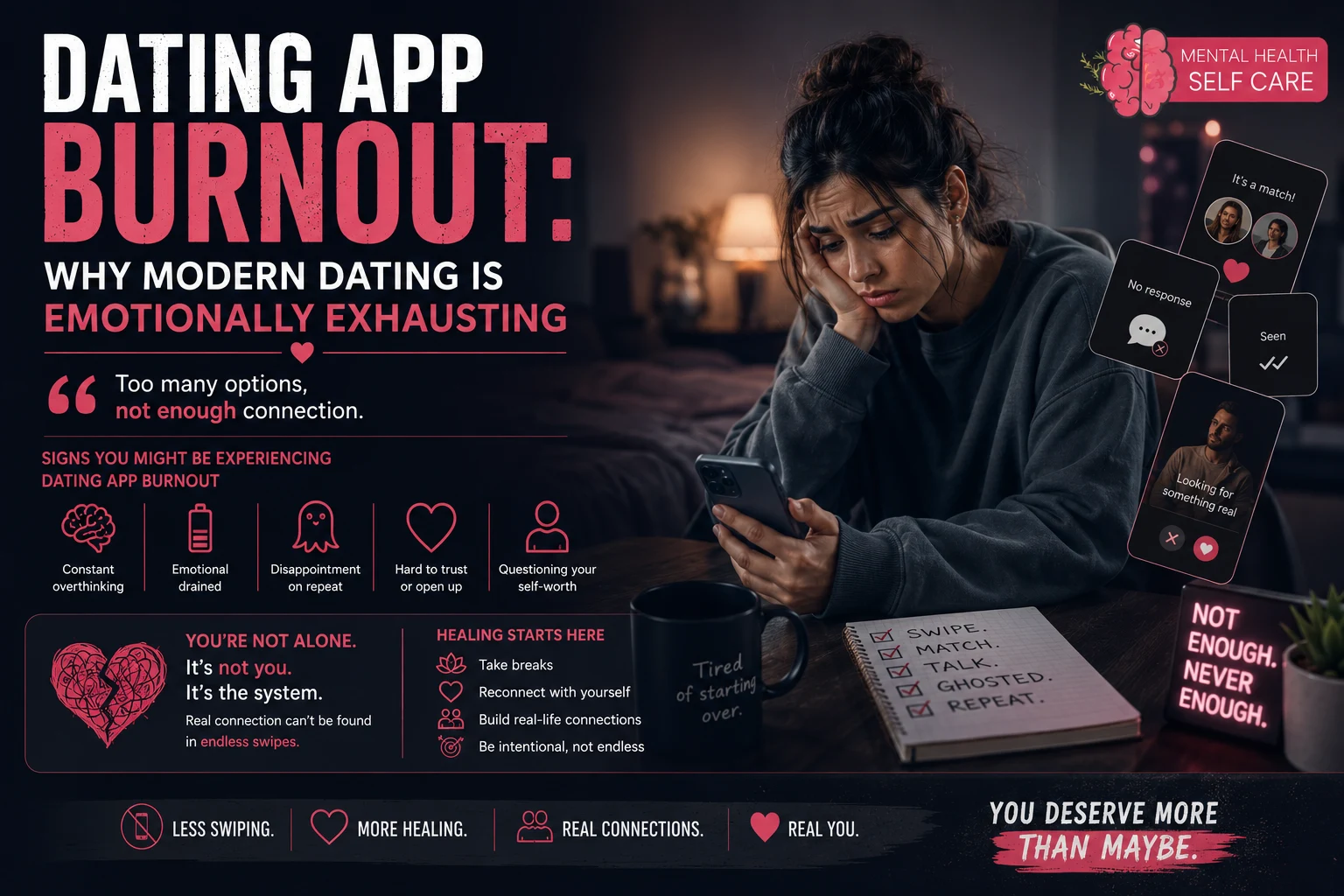
Dating app burnout refers to the emotional fatigue, irritation, and declining motivation that can develop after spending a lot of time on dating apps. What starts as the excitement of meeting someone new can slowly turn into another mental frenzy. Individuals can keep up with dating apps as they grow more disconnected from the whole process.
Today’s dating landscape offers more possible relationships than those before could readily explore, yet more options do not guarantee better emotional experiences. It takes just a few seconds to view a profile, conversations can vanish unexpectedly, and individuals can have multiple connections at the same time.
After some time, dating may begin to feel less like relationship building and more like a never-ending search through options. Studying dating app burnout can help us understand how dating affects people’s psychological well-being and when it might be healthier to take a break rather than keep swiping.
Why Dating Apps Feel Exhausting
Dating applications are not necessarily harmful. They help many people to create meaningful relationships. The emotional challenge usually comes from the number of decisions users must make, uncertainty, repetitive introductions, and rejection. When these trends persist over months, the psychological pressures of dating may mount.
Endless Choice Creates Decision Fatigue
The idea of having hundreds of possible matches might sound like an excellent benefit, but many choices can complicate the decision-making process. Users may wonder whether someone better is just a swipe away. Instead of focusing on one person, time gets split among possibilities. This excess can promote snap judgments, and commitment can seem too risky. At one point or another, assessing profiles and conversations can become mentally draining instead of exciting.
Ghosting Creates Unanswered Questions
An interesting discussion may just abruptly cease without any notice. The lack of closure when someone you’ve been communicating with for days or weeks suddenly disappears often leads to overthinking. Individuals might replay the same conversation many times and question what they did wrong. Experiencing this repeatedly can lead to emotional defensiveness. The user starts anticipating a loss of connection and becomes less willing to invest emotionally, even when they finally find someone interested.
Rejection Starts Feeling Personal
Dating involves rejection, but apps expose people to rejection more often and in less time. Matches fail to respond, chats might break, or dates can be fruitless. These experiences may over time influence self-confidence, particularly where individuals perceive it as a testament to their attractiveness or value. Dating app burnout increases when people internalize unsuccessful dating experiences rather than treating them as part of compatibility discovery.
Conversations Become Repetitive
What do you do? Where are you from? What are you looking for? Repeating these kinds of introductions across dozens of matches can make dating feel mechanical. It puts emotional energy into learning about a person, and the dialogue will fade away, and the process will be reiterated. At some point, people can respond without true interest because they are fed up with starting over again and again on a blank slate.
Signs of Dating App Burnout
Burnout does not mean you have to give up online dating forever. It can also signal an emotionally unsustainable relationship with dating apps. Knowing the red flags can help you avoid temporary frustration turning into deeper cynicism, anxiety, or harm to self-esteem.
Swiping Feels Like Work
Swiping on a dating application once brought curiosity. It is now like another burden. You swipe because you think you need to keep trying, not because you want to connect. Emotional exhaustion can set in when dating turns into an unpaid job you feel obliged to do day in, day out.
Matches No Longer Excite You
A new match or message can produce practically no emotional reaction. You may think first that the conversation is likely to vanish of its own accord, rather than out of curiosity. This emotional detachment can result from repeated disappointment. Unfortunately, it also makes it harder to identify true connections.
You Become Increasingly Cynical
Recurring bad experiences can lead to sweeping generalizations, like that no one wants to commit or even that everybody is lying on dating sites. Although a frustrating experience is a fact, imagining it in all future relationships makes you emotionally defensive. Cynicism can protect against disappointment in the short run and may reduce your willingness to be open to people who haven’t done anything to warrant mistrust.
Your Self-Esteem Depends on Matches
When compliments make you feel beautiful and downtime leaves you doubting your value, the app has too much control over your self-esteem. Matching depends on algorithms, location, preferences, profile presentation, and timing. They do not make good assessments of individual worth.
Recovering From Dating Fatigue
Dating app burnout can be cured without abandoning relationships. It involves rethinking your attitude toward digital dating in a way that will not always hurt your emotional well-being while you search for a partner. It takes boundaries, realistic expectations, and a worthwhile life even without a relationship to healthy dating.
Take Intentional Breaks
When dating gets exhausting emotionally, take a break, but do not consider the break as a failure. Several weeks off swipe cards can ease stress and make room for friendships, hobbies, work, exercise, and real-world activities. Go back when interest has mended itself instead of being pushed to the tracks by loneliness.
Stop Measuring Worth Through Attention
Matches, replies, and dates measure compatibility and platform interaction, not your value as a person. When you’re not talking, isolating self-esteem and digital attention can undermine emotional well-being. A person who decides not to maintain contact does not necessarily imply that there is something wrong with you.
Date With Clear Intentions
Knowing what you want eliminates emotional waste. Be realistic about whether you want a committed relationship, casual dating, or just to meet others. When people’s intentions are clear, it’s easier to spot incompatible connections early rather than waste energy repeatedly in areas where expectations fundamentally clash.
Move Beyond Apps
Meeting someone you like shouldn’t be based solely on dating apps or make up the core of your love life. Opportunities can be made through social activities, communities, hobbies, introductions via friends, and day-to-day interaction, without the monotony of swiping. Meeting people in different ways lessens the pressure on any platform.
Why Choose Mental Health Self Care?
The possible overlap of dating burnout with loneliness, rejection sensitivity, relationship anxiety, low self-esteem, and past emotional experiences. Mental Health Self Care offers individualized counseling services to help people understand these patterns, rather than simply telling them to work harder at dating.
Mental Health Self Care offers relationship strategy support, anxiety, emotional exhaustion, and poor attachment pattern support to individuals in 500+ counseling sessions, 5+ years, and 50+ client video testimonials. Counseling may help restore confidence in emotions, build healthier foundations, and form relationships without letting recurring frustrations undermine self-esteem.
Conclusion
Dating App Burnout occurs when the endless process of swipe, match, message, rejection, ghosting, and repeat wears on the emotions. It does not mean modern dating is a dead end or that dating apps can’t help you find meaningful relationships.
It implies that you should take care of your emotional strength.
The process can be healthier by taking breaks, setting boundaries, not tying self-worth to matches, and having a clearer idea of dating. When the causes of persistent anxiety, loneliness, low self-esteem, or emotional fatigue are due to online dating, mental health self-care can offer you some professional help to understand those patterns and form a healthier relationship with dating.
FAQs
1. What is Dating App Burnout?
Dating App Burnout is the emotional or motivation fatigue as a result of continuous swiping, chatting, rejection, ghosting, uncertainty, and poor online dating performances.
2. What are typical symptoms of dating fatigue?
Symptoms consist of no longer enjoying matchups, evading messages, cynicalism, feeling numb, obsessive swiping, and feeling poorer following utilization of dating apps.
3. Do dating apps have any impact on mental health?
Repeated rejection, comparison, doubtfulness, and compulsive use may also be contributing factors to anxiety, low self-esteem, loneliness, or emotional exhaustion for some individuals.
4. Should I get rid of dating apps when I am feeling burned out?
Not necessarily permanently. Taking an intentional break can help you recover emotionally before deciding whether and how you want to return.
5. How long should a dating app break last?
No exact schedule. Let frustration subside, and stay curious about meeting people again.
6. Does ghosting cause dating app burnout?
Yes. Repeated ghosting may lead to overthinking, rejection sensitivity, mistrust, and avoiding investing emotions in future relationships.
7. Does counselling assist dating burnout?
Yes. Relationship anxiety, self-esteem, rejection sensitivity, attachment patterns, boundaries amongst other emotional issues complicating contemporary dating can be dealt with through counseling.
Pingback: Situationship Anxiety: Why Undefined Relationships Cause Anxiety
Pingback: Digital Anxiety Symptoms: Why Digital Stress Is Rising