
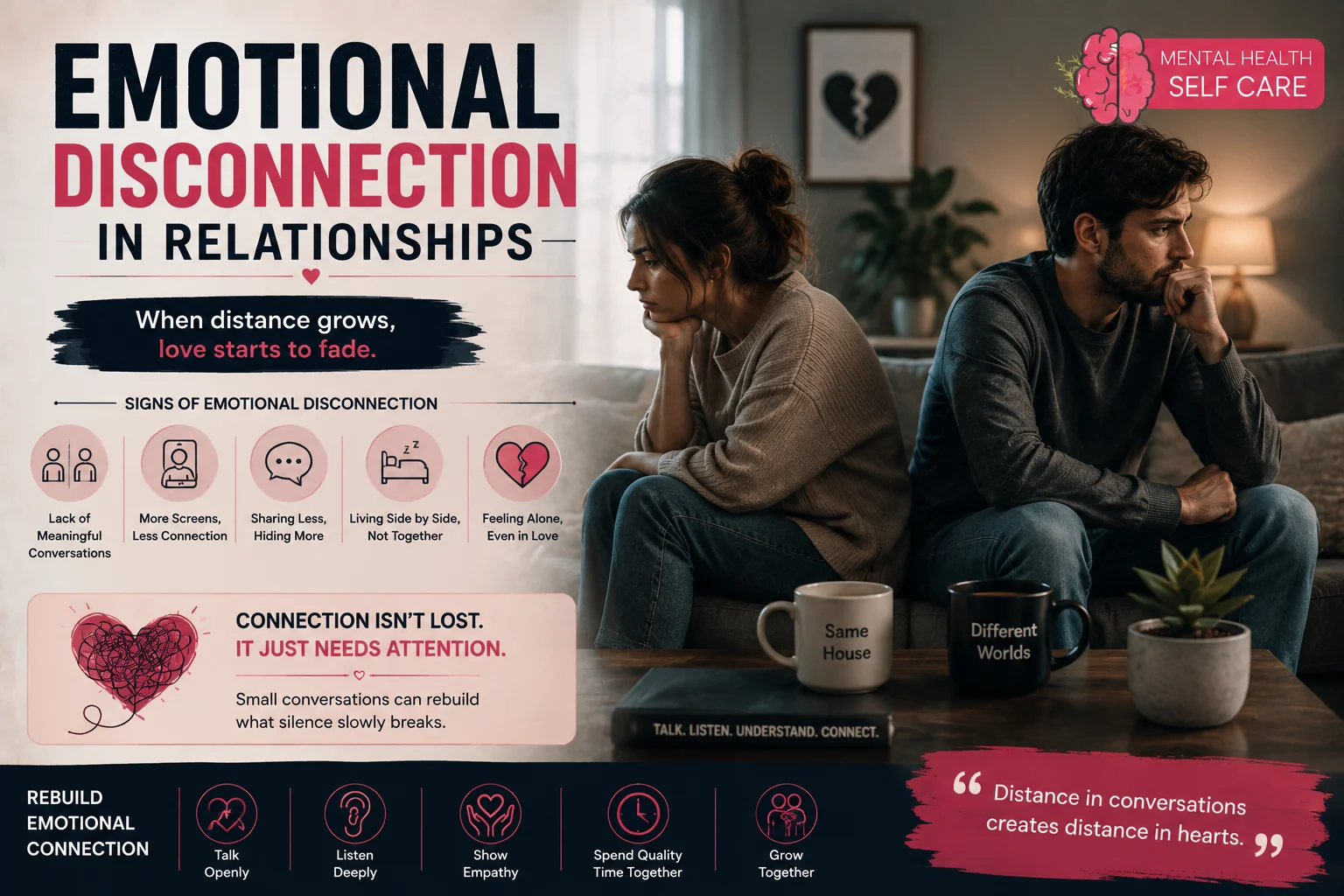
Emotional disconnection in relationships can leave couples feeling lonely, even when they live together, share responsibilities, and spend the same room daily. This loneliness can stem from reduced emotional talk, routine affection, unresolved conflicts, growing distance, and partners not feeling truly seen and understood by the other. Emotional proximity cannot be substituted with physical presence.
Such a kind of loneliness is especially confusing, as the relationship might appear utterly normal on the surface. Couples can dine together, take care of their house, have kids, go out, and sleep together, but secretly experience loneliness. This transforms into a working relationship rather than an emotional one.
Understanding why emotional disconnection in relationships happens matters, since emotional distance doesn’t necessarily mean love is gone. In most relationships, it is an indication that bondage has been forgotten and requires conscious effort.
Why Couples Feel Lonely Together
Relationship loneliness rarely begins with one dramatic event. More often, emotional intimacy is lost in hundreds of tiny ways: couples no longer share, listen, respond, or make space for each other. It is possible that life is being led, purring and persistently, and silently, while intimacy withers away. Knowing these trends can help couples recognize when emotional disconnection has become emotional distance, before distance becomes their new normal.
Conversations Become Purely Practical
Couples can talk every day without having a meaningful conversation. Talking is confined to bills, children, groceries, appointments, work at home, or work schedules. Practical communication is necessary, but it cannot sustain emotional intimacy on its own.
As couples stop sharing their fears, dreams, disappointments, inner experiences, and how they are truly experiencing life, they eventually learn less about each other. At some point, cohabitation may begin to feel more like living with a housemate than with a partner.
Feeling Unheard Creates Loneliness
Loneliness can start when one partner keeps trying to communicate but doesn’t feel understood. Their issues can be discounted, interrupted, downplayed, or even countered with advice rather than sympathy.
Once their disappointment in conversation becomes consistently high, they may give up. Vulnerability is then replaced with silence because it no longer feels worth opening up. The other partner might take this silence as all being well, while the emotional distance grows. Feeling truly heard is therefore critical to rebuilding emotional security and connection.
Affection Becomes Automatic
Being physically close does not mean being emotionally intimate. A quick farewell kiss, sitting in the same place with different phones, or the same routine of going to bed may still exist even after meaningful affection has suffered.
Other healthy intimacy elements include inquisitiveness, listening, warmth, appreciation, and emotional presence. When affection becomes something couples do without truly experiencing it, one or both partners can start to feel invisible. This lack of emotion may significantly contribute to emotional disconnection in relationships.
Unresolved Conflicts Build Invisible Walls
Not all conflicts should be resolved flawlessly, but over time, ignoring pain leaves a trail of emotional debris. Past disagreements, missed commitments, heartaches, or silent fury may progressively render couples more defensive with one another.
They might avoid discussing certain things because they anticipate another argument or feel nothing will change. At some point, emotional self-protection supersedes openness. On the surface, couples may live happily without ever resolving issues that could bring them closer.
Signs Emotional Connection Is Fading
It can be hard to notice emotional disconnection in relationships because the relationship seldom changes overnight. Couples can become accustomed to the growing distance until behaviors that would otherwise raise concern become the new norm. Identifying these changes early creates a better chance to address the root of the problem before loneliness leads to resentment, indifference, or a severe rupture in the relationship.
- You Stop Sharing Small Things
- Silence Feels Easier Than Talking
- You Feel Alone During Difficult Moments
- You Function More Like Roommates
What Causes Emotional Disconnection in Relationships?
Couples don’t decide to become emotionally detached. Disconnection normally occurs when daily stressors, unmet emotional needs, and maladaptive relationship patterns insist on taking over intimacy. Understanding which factors created the distance matters, since different causes require different solutions. It is best to address the underlying cause of emotional disconnection in relationships rather than merely trying to spend more time together.
Stress Leaves Nothing for the Relationship
Most of an individual’s emotional energy can be absorbed by career pressure, parenting, finances, caregiving, and household responsibilities.
At the close of the day, couples might not have much patience or interest to give each other. Neither person necessarily intends to neglect the relationship, but connection becomes something postponed until life gets easier.
The thing is that life can be long and hectic. Chronic stress might slowly transform loving partners into two individuals who have to cope with responsibilities as an effective pair without paying special attention to protecting their emotional time.
Vulnerability Starts Feeling Unsafe
Emotional intimacy involves individuals sharing feelings they don’t fully control. If prior experience with vulnerability has led to criticism, dismissal, mockery, anger, or indifference, a partner can end up being warmed into guardedness.
It makes them less likely to share, since emotional self-protection feels safer than the risk of being let down by another reaction. Reconnection goes beyond prodding someone to open up. Both spouses must create a space where they can speak the truth respectfully, without it becoming a weapon in future conflict.
Technology Robs Group Attention.
Phones themselves are not the cause of relationships, but the divided attention all the time can. Instead, a couple can spend a whole evening together and not talk to each other at all as both scroll through messages, work on something, or watch something different. Such disruptions cut off numerous spontaneous dialogues in which intimacy would take its natural course. Emotional Disconnection in Relationships can arise when screens demand constant attention and a partner is left with what is left. By establishing device-free time, couples can be present with each other, not just physically close.
Needs Remain Unspoken for Too Long
Couples often expect love to reveal their needs. One might want more love; another might need reassurance, more time together, appreciation, or stronger emotional support. In such cases, when these expectations are not spoken, disappointment develops around expectations the other person may not be able to understand. Sooner or later, direct communication is substituted with assumptions. Clear discussion of emotional needs does not ensure all expectations will be met, but it gives both spouses a realistic chance to see what remains unmet and respond positively.
Rebuilding Emotional Connection
Regaining emotional closeness takes more than scheduling a few time-out dates or a few extra hours together in the same room. Couples should rekindle curiosity, emotional safety, communication, and responsiveness. If both partners are ready to examine their part in the distance, they can change it. Minor repeated efforts tend to mend emotional disconnection in Relationships better than infrequent dramatic gestures.
Start Talking Beyond Responsibilities
Prepare discussions that aren’t about schedules, children, bills, or domestic chores. Inquire about what has been on the mind of your partner, what they are currently concerned with or what they are waiting for. Meaningful communication doesn’t have to turn into a heated relationship talk every night. Regular curiosity helps partners rediscover each other’s inner world and slowly shifts communication from functional to genuine emotional connection.
Listen Before Trying to Fix
When one partner shares something hard, offering a solution right away may unconsciously make them feel unheard. They should be advised by providing empathy at times.
Psychological safety is created by listening, acknowledging the feeling, and asking what type of support they need. This is especially significant when couples have established defensive communication patterns in the past.
A sense of being understood fosters more vulnerability, and when they experience consistent safety in their vulnerability, those repeated instances help restore the trust needed to open up emotionally.
Address Resentment Directly
Unresolved resentment seldom fades away just because couples stop talking about it. Rather, it usually affects attitude, love, tolerance, and subsequent conflicts. Couples must learn to recognize frequent injuries and communicate about them without turning the dialogue into a contest over who had more injuries.
They may require accountability, heartfelt apologies, behavior change, and realistic expectations. When discussions become increasingly aggressive or fruitless, relationship guidance may help create a more orderly space for tackling challenging matters.
Protect Time for Connection
Quality time shouldn’t be based solely on having nothing to do. Couples can strategically set aside time when work, phones, and household duties are put on hold. It is not the activity but actual involvement. Walking together, eating without devices, sharing coffee, or having an uninterrupted conversation can all strengthen connection. Consistency shows that the relationship is a priority, not something addressed only after all other tasks are finished.
Conclusion
Emotional Disconnection in Relationships is a book that explains why two individuals may live together, share duties and routines, and even love each other, yet still feel very lonely. It need not be a shortage of physical presence. It is the deprivation of emotional attention, vulnerability, understanding, and meaningful connection.
Neglecting the fact that loneliness may enable resentment and apathy to thrive. The sooner it is addressed, the more likely couples are to know what has changed and recycle what has been lost.
Mental Health Self-Care helps people and couples examine the emotional dynamics that create distance in relationships through individualized counseling and supportive guidance. When your relationship has become more of a coexistence than a connection, you may need professional assistance to understand why and begin reestablishing communication, trust, and emotional intimacy.
FAQs
1. What Is the Reason behind Emotional Disconnection in Relationships?
Typical reasons are conflict left unresolved, ineffective communication, chronic stressors, emotional disconnection, less quality time, distraction by technology, unmet needs, and being perceived to be continually unheard or unsupported.
2. Do you experience being lonely in a healthy-looking relationship?
Yes. One may seem to be in a solid relationship, but either partner may be emotionally lonely. Coexisting and living together does not necessarily form emotional closeness.
3. How do you know that you are emotionally disconnected?
A few meaningful conversations, less affection, unwillingness to be vulnerable, feeling unsupported, and living like roommates rather than romantic partners are common signs that you are not getting along.
4. Does emotional aloofness imply that the relationship is dead?
Not necessarily. In some instances, emotional distance can be mended when the couple is aware of the issue and consistently strives to communicate, build trust, overcome conflicts, and show sensitivity.