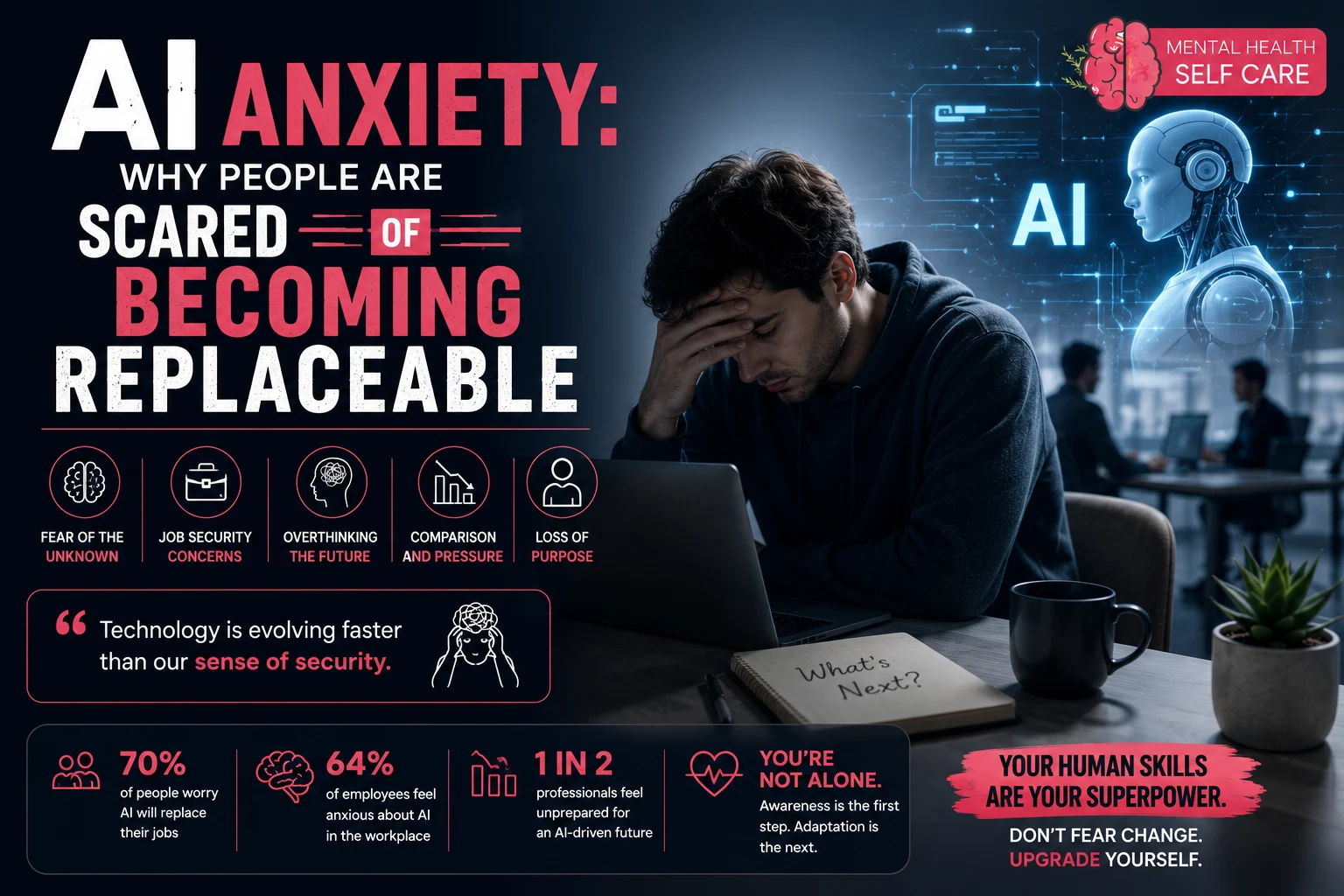
AI anxiety refers to the growing fear that artificial intelligence might replace individuals’ occupations, careers, talents, economic stability, and relevance over time. As AI tools become capable of completing tasks once performed exclusively by humans, many workers are asking an uncomfortable question: What happens if technology can eventually do what I do?
This is not any technology-related phobia of mine. Knowledge workers such as writers, designers, marketers, programmers, customer service professionals, accountants, analysts, and so on are finding AI a part and parcel of their daily lives.
It is understandable that some apprehensions about discontinuity are justified, whereas perpetually envisioning the worst will simply cause persistent stress. It is important to know what distinguishes realistic career-related issues from an unhealthy AI job-grabber.
To cope with AI anxiety, you don’t need to ignore technological change. It involves learning how to react to uncertainty without letting it dominate your mental health.
Why AI Anxiety Is Growing
Artificial intelligence is evolving rapidly, so employees may barely have time to fully understand one change before another emerges. Will uncertainty increase through headlines of automation, layoffs, new AI functionality, and vanishing jobs? Meanwhile, employers are demanding that workers change. This mix is generating AI job anxiety among even skilled workers who had never experienced job insecurity before.
Fear of Losing Your Job
Fear of losing a job is the easiest-to-identify source of AI anxiety. When the audience reads about software creating content, designing, processing data, writing code, or automating administrative tasks, it is natural to compare these abilities to their own. This uncertainty is especially stressful when it is unclear how fast a profession will evolve. Although the jobs of workers whose jobs are not in danger at the onset could begin to worry whether they will have a job in five or ten years.
Skills Suddenly Feel Less Valuable
It really takes years to build and develop the expertise that makes up professional identity. An AI system’s ability to accomplish a similar task in seconds may generate more than professional confusion. It can undermine one’s personal worth.
Questions like, “Why did it take me years to learn this? Or what am I of value now? may become incessant. This anxiety about AI may undermine confidence, even when a person’s overall judgment, experience, communication, and problem-solving skills are still useful.
Constant AI News Increases Fear
AI developments are no longer portrayed as separate stories; they appear almost constantly on social media, news outlets, professional websites, and in the workplace. Headlines often highlight dramatic possibilities because unpredictability grabs attention.
Each time people consume this information, it can make remote possibilities seem real and even unavoidable. Individuals can start obsessively reading AI news, comparing themselves to new technologies, or panicking with each new function announced. This cycle can turn healthy awareness of technological change into chronic technology anxiety.
Workplace Expectations Keep Changing
Not all professionals worry about being cream-skinned. They are fed up with the idea that they need to keep learning new tools in order to stay competitive. What was a perfect workflow an hour ago suddenly changes.
Without more time and training, employees can be pressured to work faster, more productively, and become technologically competent. This continuous change brings about anxiety in the workplace regarding AI and even more so for individuals who are already stressed by the prevailing tasks.
Signs AI Anxiety Is Affecting You
Fear of changing professions is not necessarily a psychiatric issue. A little uncertainty is rational when an industry is experiencing severe technological disruption. The issue starts when anxiety is repetitive, disproportionate, or uncontrollable. Understanding the manifestation of AI anxiety symptoms in real life can aid in separating knowledgeable planning from fear that is harming their emotional health.
You Constantly Compare Yourself With AI
Itis reasonable to use AI every now and then to figure out what it can do. It may be emotionally devastating to repeatedly test whether it can do every aspect of your job. Every new skill can make it seem like your job is going away.
You start treating any improvement as a personal threat instead of seeing AI as one facet of the transforming workplace. This comparison can undermine your professionalism and further complicate identifying the human skills and experience you continue to bring.
Every AI Headline Feels Personal
The news about a new AI model, company announcement, or automation story can instantly make people think about unemployment or financial insecurity. The thought of AI is capable of doing this has flew through the head to I will lose my job. It is at this jump between possibility and certainty that reasonable apprehension is transformed into excessive worry. Once each of the developments brings emotional distress, insomnia, or obsessive research, AI Anxiety might be influencing not just your professional planning.
You Cannot Stop Thinking About Job Security
When career planning results in action, it is productive. Anxiety is different. The questions are the same, and there will be no answers: Will my occupation fade away? Will early workers change more quickly? What will happen should my salary decrease? What will I do to take care of my family?
As these thoughts persist into evenings, weekends, conversations, or even trying to sleep, the brain does not actually have a real break of uncertainty. Anxiety about being replaced at work may slowly erode focus, feelings, relationships, and quality of life.
You Feel Pressure to Learn Everything
It is impossible to master all the new AI platforms. However, fear has the power to make you feel that you are not good enough without this or that tool; that you will not be relevant in your profession. Individuals enroll in courses, use inexhaustible AI accounts, test all applications, and still feel behind.
At that point, learning is no longer fuelled by interest or a professional plan but by panic. To live sustainably means that you must also determine which technology can play a role in your job instead of trying every one of the developments, as it will enable you to succeed.
How AI Anxiety Affects Mental Health
Anxiety about AI may be work-related, but fear can go beyond that because employment is also closely tied to income, identity, stability, and future planning.
When uncertainty is chronic, the mind can be occupied with the possibility of loss, even when there is no job loss in the moment. Effective emotional health, workplace effectiveness, relationships, and making significant life choices may be affected by unresolved fear of artificial intelligence over time.
Confidence Begins to Decline
Constant comparison of human capabilities with increasingly competent technology can lead a person to underrate their own experience. They might begin to wonder whether their knowledge is still relevant or whether what they have achieved has any significance. This lack of confidence can be self-defeating.
A person whose worries include becoming professionally worthless might cease providing ideas, applying skills to chances or career risking. The key to managing AI anxiety is to maintain realistic self-belief while staying open to mastering new skills.
Work Becomes Emotionally Exhausting
An individual who sees AI as a constant threat will view regular workplace changes with fear. Replacement is evidenced in new software.
A productivity program feels like a layoff. A manager talking about automation sends shivers. This degree of alertness is psychologically tiring.
Even when employment is steady, the individual may feel they are already losing their job and experience stress. Workful life is also an episode where chronic uncertainty can greatly be an emotional toll.
Future Planning Feels Unsafe
Career uncertainty may also extend to financial and personal choices. Uncertainty about how AI will affect people’s earnings may make them hesitate to switch jobs, buy a house, have a family, invest, or change careers.
A degree of prudence is wise, yet expecting absolute assurance before making a choice can cause life to stall. There is no generation that has had an unblemished insight into the future of work and AI cannot alter that basic fact.
How to Manage AI Anxiety
Managing AI anxiety does not mean convincing yourself that artificial intelligence will never disrupt your career. Some jobs will change, certain tasks will become automated, and new skills will become more valuable. A healthier response is to separate realistic risks from imagined worst-case scenarios, focus on what you can control, and build adaptability without turning career development into a constant source of fear.
- Focus on Skills AI Complements
- Stop Consuming Every AI Update
- Build a Realistic Career Plan
- Protect Your Mental Health
Explore here to walk on the journey of mind and body reset.
Conclusion
AI anxiety reflects a real concern in today’s workplace. Artificial intelligence is changing how many things are done, and it’s unrealistic to pretend there will be no change. However, thinking that every new AI function will cost you your job is equally unhelpful. Denial and panic are inappropriate responses.
Know your profession is evolving. Learn competencies that enhance your worth. Acquire pertinent technology without attempting to learn all. Above all, don’t let tomorrow’s worries take a toll on your mental state today.
Mental Health Self Care offers individual counseling to people with AI anxiety, career indecision, overthinking, and work-related stress. A professional can help you manage the emotional side of technological change and make clearer, calmer decisions about your future.
FAQs
1. What is AI Anxiety?
AI anxiety refers to fear, stress, or persistent uncertainty related to artificial intelligence and its potential impact on employment, professional skills, financial security, privacy, society, or the future.
2. Why am I scared AI will replace my job?
The fear often develops because AI can automate tasks previously completed by humans, while predictions about future job disruption remain uncertain. Repeated exposure to alarming AI news can intensify this concern.
3. What are common AI Anxiety symptoms?
Possible AI anxiety symptoms include persistent worry about job security, compulsively following AI news, difficulty sleeping, reduced professional confidence, concentration problems, and feeling pressured to continuously learn new technologies.
4. Is fear of AI replacing jobs realistic?
Some concern is realistic because AI is changing tasks and occupations. However, the extent and timing of job displacement vary considerably across industries. Treating every profession as inevitably disappearing oversimplifies a complex transition.
5. How can I reduce workplace anxiety about AI?
Focus on relevant skill development, understand how AI affects your specific role, limit speculative content, build a realistic career plan, maintain professional relationships, and protect time away from work-related concerns.