
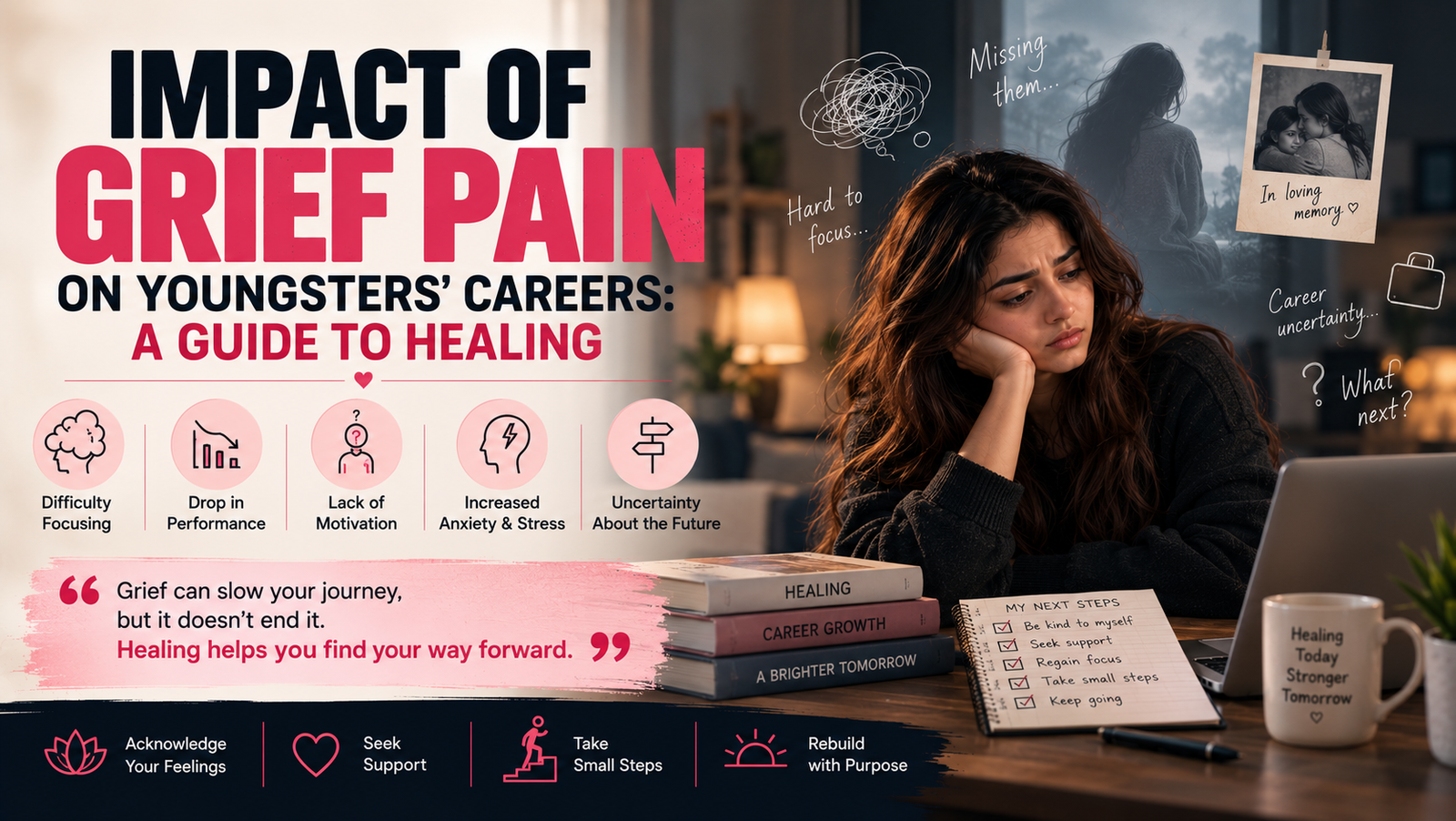
Grief pain in youngsters’ careers can affect concentration, motivation, confidence, decision-making, and professional growth as they try to cope with the loss of someone important. Grief pain does not stay confined to emotions. It can affect work, research, personal interactions, sleep, energy, and their ability to plan for the future.
Even during heartbreak, bereavement, family loss, or other traumatic life changes, young adults are expected to keep building their careers. From the outside, it can seem that they are functional, but on the inside, they are unable to concentrate or seek purpose in the previously important goals.
Grief healing does not imply forgetting the experience or the person. It means slowly learning to bear the loss while restoring emotional stability, daily organisation, and trust in the future.
How Grief Pain Affects Career
Grief pain can affect professional life, and it’s easy to misinterpret. A young person may seem lazy, distracted, or unmotivated when they are actually overwhelmed by their emotions. The mind and body may need time to adapt to a significant loss.
Concentration Becomes Difficult
Even the simplest work may become a psychological strain as a result of grief.
A young professional may read the same email multiple times, forget instructions, miss deadlines, or struggle to concentrate during meetings. Their thoughts may keep returning to the memory, unresolved questions, or the events surrounding the loss.
This low level of concentration does not always indicate low ability. Emotional pain consumes attention that would normally go toward work, learning, and problem-solving.
Grief can be so strong that trying to maintain normal productivity right away can cause more frustration and self-blame.
Motivation Starts Declining
Unless a big loss happens, career goals may suddenly lose their significance.
A job promotion, exam, or professional success that was once exciting might no longer motivate. Some start to doubt why they are struggling so hard, yet there is no one important to share their success with.
Such demotivation can lead to career delays when it persists over a long time.
Instead of pushing themselves to be enthusiastic, it may be healthier to focus on maintaining routine duties while emotional energy rebuilds.
Confidence Can Fall
Grief is a process that can alter how individuals perceive themselves.
Adolescents who used to be emotionally stable, feeling self-sufficient and ambitious, might be emotionally vulnerable all at once. If their workplace performance also declines, they may begin to think they are losing their ability.
Any mistakes that otherwise would have been manageable may become evidence in their mind that they are falling short.
Such emotional suffering and low professional confidence may push individuals to avoid opportunities, interviews, new duties, or job decisions, even when patience and support could help.
Career Problems After Loss
The effect of bereavement and work stress may be exacerbated by the continued professional involvement without sufficient emotional rest. Young people may feel pressure to seem normal because they fear that talking about Grief pain will change how employers or colleagues see them.
Productivity May Drop
Grief may impair energy, memory, sleep, and attention. This means work could slow down. A young worker may procrastinate, make more errors, or struggle to handle multiple tasks at once.
Working more hours to counter this may not reduce exhaustion. Grief can be managed by making temporary changes and setting more realistic goals and expectations.
Career Decisions Feel Confusing
A great loss may transform a person’s priorities.
One may feel like quitting their job, relocating to a different city, leaving their profession, or taking an entirely new turn. In other situations, such choices can indicate real personal development. They can also be responses to severe emotional pain in others.
Whenever possible, don’t make irreversible career choices when you are overpowered by grief.
When you take time to think, you can distinguish between a thoughtful career change and a move driven by painful feelings.
Isolation Makes Work Harder
Some people withdraw after loss because social interaction feels exhausting.
They may stop speaking with colleagues, decline invitations, avoid friends, and become emotionally distant at work.
Temporary isolation can be beneficial, but in the long term, isolation can add to loneliness and complicate grief.
Even one trusted colleague, friend, mentor, or family member can minimise the feeling that you have to go it alone.
How Youngsters Can Heal
Grief recovery doesn’t follow a schedule. Some days may feel manageable, while others find you unexpectedly in the midst of sorrow. The recovery process is not consistent.
The aim isn’t to fix grief in a moment but to build habits and support systems that support emotional healing and slowly restore career stability.
Give Yourself Realistic Expectations
Never compare your current productivity to what you did before the loss.
Your mental and emotional resources may be temporarily reduced.
Break big tasks into smaller parts and identify only the most important priorities for each day. It is usually more productive to get the basic work done than to push yourself to work at peak productivity.
The grief process may seem to be moving more slowly than you’d like, but slower is better than no progress at all.
Rebuild Daily Structure
The loss may disrupt sleep, diet, physical activity, and daily life.
When feelings are unstable, you can regain a sense of stability by restoring basic structure.
Try to keep consistent sleep and wake times, eat regularly, take short walks, and set specific times for work and personal recovery.
A predictable routine won’t eliminate grief, but it can help avoid needless chaos and let your mind feel safe and in control.
Talk About What You Feel
Grief cannot always be diminished by means of suppression.
You might have to be able to discuss the person you lost, the future you would have had, your anger, your guilt, your sadness, or your confusion.
Choose people who can listen without forcing you to “move on.”
In case you cannot share these feelings with your family or friends, professional counselling may give you space in which you can process grief in a non-judgmental manner.
Return to Goals Gradually
Career ambition doesn’t have to disappear because of grief.
Begin with less ambitious professional objectives. Take one course, hone one skill, refresh your CV, complete one project, or simply re-establish consistency at work.
Reconnecting with meaningful goals can help you re-identify with yourself beyond grief.
Your career does not have to be a distraction from loss. It may eventually be incorporated into reconstructing a meaningful life afterwards.
Why Choose Mental Health Self Care?
It is not only sadness that can be influenced by grief. Grief can also affect self-esteem, focus, social life, career choices, sleep, and mood.
Mental Health Self Care offers self-counselling to help individuals understand difficult emotions, develop healthy coping mechanisms, and re-establish themselves as they adapt to significant life changes.
500+ Counselling Sessions
Mental Health Self Care has over 500 counselling sessions, helping individuals overcome grief, stress, emotional pain, overthinking, relationship issues, and other mental health difficulties.
5+ Years of Experience
Radheshyam More has 5+ years of counselling experience, helping people understand emotional patterns and develop practical coping mechanisms for challenging life issues.
50+ Video Testimonials
Over 50 client video testimonials from people supported by Mental Health Self Care. Each person’s grieving process is unique, and counselling is tailored to their needs rather than guaranteeing a path to recovery.
Conclusion
Grief pain in young adults’ careers can affect focus, motivation, confidence, productivity, and important professional decisions. Young adults may feel pressured to keep moving on while internally processing a loss that has altered their view of life and the future.
Healing does not require forgetting what happened.
It is about letting grief be and slowly rebuilding routines, relationships, emotional capacity, and career aspirations.
If Grief pain makes it hard to work, study, sleep, concentrate, or move forward, mental health self-care can offer personalised counselling support. Radheshyam More assists people in learning about emotional pain, finding practical coping skills, and slowly finding balance so that grief does not dictate what their future career path will become.