To what extent can a person play multiple roles before it starts affecting her from within?
A professional at work. A daughter, wife, or mother at home. A permanent problem-solver, nurturer, actor and decision-maker.
Appearing externally, it resembles balance.
On the inside it seems to be pressure.
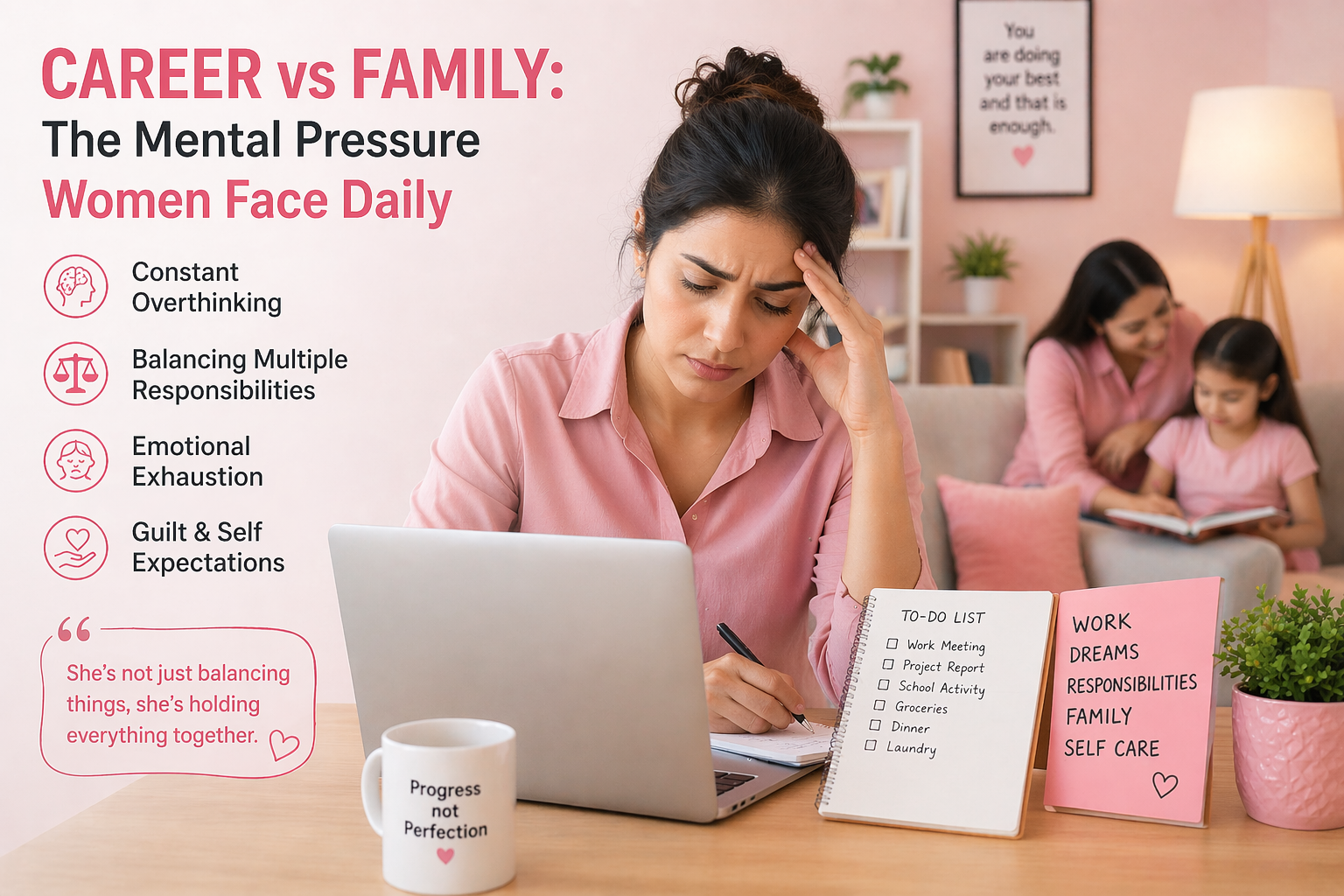
Women are doing more than ever before IN 2026. They are establishing their careers, raising families, keeping home, and yet expected to get everything running smoothly. And with this strength one thing stands behind it that many would not see that is constant mental strain.
This day to day strain does not necessarily manifest itself as breakdowns. It manifests itself in the form of overthinking, exhaustion, emotional load and mental pressure. And neglected, it begins to have more significant Mental Health implications.
What Do You Know About Career vs Family Pressure?
It is not a question of career or family.
The difficulty is attempting to put 100 per cent into it, at all times.
Women today face:
- Performance pressure and work deadlines
- Household responsibilities
- Emotional expectations from family
- Social demands to handle it all
This puts an unending mental pressure that is not often addressed but immensely affects Mental Health.
Why This Pressure Is Increasing in 2026
There has been an increment in the expectations yet there has not been a corresponding adjustment of the support systems.
Bi-directional work without a clear definition.
- Emergence of work cultures of demand
- Extrinsic pressure and social comparison
- Personal time deficiency
- Unemotional expectations and unsentimental support
This is one of the largest causes that women are currently undergoing greater levels of stress that affects their Mental Health.
How Career vs Family Pressure Affects Mental Health
Constant Mental Load That Never Switches Off
The mind remains active even after tasks have been accomplished. Planning, remembering, managing, anticipating, mental checklist is endless. This is a non-stop interaction that leaves no room to rest. This unseen burden consumes energy and it impacts Mental Health, so relaxation seems to be challenging over time.
Emotional Exhaustion From Being “Available” All the Time
Women have to be the emotional providers of all.
- Supporting family members
- Managing relationships
- Handling emotional situations
The continuous involvement of emotions results in fatigue, in which giving is automatic but there is little receiving of support. This disproportion directly affects Mental Health.
Guilt From Not Being Able to Do Everything Perfectly
Whatever one does, it always seems to be not enough.
- Feeling guilty of not spending more time with family
- Cone of consciousness to work
- Feeling guilty about spending time on myself
This conflict within makes stress and impacts on Mental Health, and it is more difficult to be satisfied/peaceful.
Overthinking and Decision Fatigue
Balancing between a number of roles implies a decision-making process.
- Work-related decisions
- Family-related choices
- Daily responsibilities
In the long run, it causes mental exhaustion, as even minor choices become exhausting. This decreases clarity and impacts Mental Health.
Lack of Personal Time and Mental Space
The lack of time is one of the greatest challenges.
- Short time resources to self-care
- No mental break
- Permanent activity of tasks
The mind does not have the time to rest without personal space and thus causes long term stress.
Pressure to Meet Unrealistic Expectations
Women are expected to excel in everything by society.
- Be successful professionally
- Be perfect at home
- Stay emotionally strong
These ideals are not necessarily real but they put a pressure that is always present and influences Mental Health.
Signs This Pressure Is Affecting Mental Health
- Getting restless all the time
- Increased irritability
- Difficulty focusing
- Emotional overwhelm
Lack of motivation
These are not small issues. They are signs of mental health issues and show that your mental health needs proper care and attention.
How to Manage Career vs Family Pressure Effectively
The problem of balancing career and family is not simple a matter of time. It is a psychological coping struggle. It is the stress when you are always changing roles and can not rest as your mind is loaded with the expectations of one place to another. The key to doing this is to establish clarity, minimize internal pressure, and establish systems that contribute to your Mental Health on a daily basis.
Create Clear Mental Boundaries Between Work and Home
Separations being absent is one of the largest causes of pressure accumulation. Stress in work accompanies you home and family duties keep you busy at work. This overlapping allows your brain to be busy at any given time. Setting up clearer boundaries, even more basic ones such as a transition routine after work, can help your mind to rest down and safeguard your Mental Health against sustained overload.
Redefine “Balance” Instead of Chasing Perfection
It is impractical to focus on providing equal energy on everything at all times. There are days that you will be in the career that will require your time more and the family on other days. This flexibility is tolerated and lessens guilt and conflict. As soon as you quit the pursuit of perfection and begin to concentrate on the things that will matter the most in the present, your Mental Health is less pressured and stabilized.
Prioritize Tasks Based on Impact, Not Urgency
When the responsibilities are high, everything can be urgent. All things, however, are not equally important. Training on prioritizing activities in terms of their impact assists in minimizing decision fatigue and cognitive overload. The fact that your mind is aware of what actually requires attention will help eliminate overworking your mind, which translates directly to improved Mental Health.
Build a Daily “Mental Pause” Into Your Routine
It is not only your body that requires rest. Even 10-15 minutes of a conscious rest throughout the day can revitalize your thoughts. This may be as simple as taking a stroll, relaxing, or even taking a break. These breaks inhibit intellectual buildup and assists in ensuring there is a balance of emotions, which is crucial in stable Mental Health.
Let Go of Guilt Around Personal Time
Most of the women find it difficult to pamper themselves without guilt. However, the mind never gets the opportunity to rest with no personal time. The little time you take to yourself is not an abdication of duties, it is enhancing your power to cope with them. You will find your Mental Health is better when you enable yourself to recharge and then everything will be easier to handle.
Share and Delegate Responsibilities Without Hesitation
Making an effort to do everything on your own adds physical and mental stress. Outsourcing, at home or in the workplace is not a virtue, it is a plan of action. By sharing responsibilities, the mental load is cut and your mind is free to breathe and work well, a positive contribution to Mental Health.
Manage Overthinking Before It Builds Up
The father factor is overthinking, which is one of the greatest magnifiers of pressure. When your mind continues to revisit the scenarios or think a lot, it exhausts easily. It can be controlled by simple activities such as writing down what one is thinking and concentrating on one thing at a time or by using fast mental reset techniques. Less overthinking is a direct way of improving your Mental Health.
Set Realistic Expectations for Yourself
Among the greatest causes of stress are unrealistic expectations. It does not mean that you have to excel at everything. Embracing your boundaries and being able to work within them makes the pressure on you interneally less. With realistic expectations, your mind is not burdened, and your Mental Health is more natural.
Create a Clear End to Your Day
When your day does not seem complete; your mind is active even when you are asleep. Getting your brain to a close is as easy as creating a simple end-of-day routine, such as reviewing work or thinking over the next day. This will assist you in detaching yourself and avoiding any carry over stress and enhances your Sleep and Mental Health.
When You Need Additional Support
It is not always easy to cope without any help.
- Constant stress
- Emotional exhaustion
- Feeling overwhelmed
Professional mental health services can bring clarity and help in such situations.
Working with a mental health recovery expert helps in:
- Understanding mental patterns
- Reducing emotional overload
- Building structured routines
- Improving long-term stability
Why Choose Mental Health Self Care?
Balancing the demands of work and family is not merely a question of improved planning.
It is about having an ordered, well organized system that holds your mind steady even at a time when the demands are much.
The majority of the women are not in need since they cannot struggle.
They are not coping since they are managing it without a mechanism that will give them the Mental Health they need.
And therein lies where Mental Health Self Care comes in.
It is structured to relate to real-life and not ideal situations.
Built Specifically for Women Managing Dual Responsibilities Daily
Mental Health Self Care is not generic counselling. It is offered to people who have to strike a balance between work, family, and emotional demands at the same time.
- Pay attention to real life issues, such as time pressure, emotional load, and decision fatigue.
- Manages work-related and personal stress.
- Helps you work more effectively without neglecting duties.
This renders it extremely applicable to enhance Mental Health in a daily life.
Deep Mental Pattern Correction Instead of Surface-Level Advice
The majority of the solutions instruct you to do something. Few assist you on the reason that your thoughts respond in a certain manner.
Mental Health Self Care is engaged in:
- Overthinking patterns
- Guilt-driven thinking
- Emotional pressure loops
- Constant mental load
By correcting these patterns, your Mental Health is not only being improved but in the long run.
Structured Mental Clarity System With Step-by-Step Progress
You do not receive unoffered counsel. You are provided with a straight trail.
- Specified strategy to diminish mental load
- Gradual development of clarity and control of emotions
- Regular monitoring of mental patterns and changes
This framework will make your Mental Health get better in a quantifiable and consistent manner.
One-on-One Focused Support That Adapts to Your Life
You have your own set of things and your way out ought to resemble it.
- One-on-one sessions according to your routine and pressure points
- Safe and confidential space to express without judgment
- Point-blank attention to your particular triggers
This personalized process will assist you to take back control of your Mental Health sooner.
Practical Daily Techniques That Fit Into Busy Schedules
You do not have to spend hours of leisure time sharpening the head.
- 10–15 minute mental reset practices
- Simple thought-management tools
- Simple routines that can be incorporated in routine life
These resources enable you to enhance your Mental Health without interfering with your duties.
Noticeable Improvement in Mental Stability Within Weeks
It is not a protracted, hazy procedure.
Regularly, people usually undergo:
- Less overthinking in 2-3 weeks
- Better emotional balance
- Improved focus and decision-making
- Reduced stress levels on a daily basis
It is not just that your Mental Health feels better but it is also more controlled and predictable.
Designed for Long-Term Balance, Not Short-Term Relief
Relief comes easy in a temporary manner. Moderation is uncommon.
With Mental Health Self Care, you:
- Be able to deal with pressure without having to feel overwhelmed
- Be clear on a hectic day
- Avoid burnout before it accumulates
- Be emotionally relaxed during difficult moments
This will make sure that your Mental Health does not need to suffer despite the growing responsibilities.
Conclusion
Finding the right balance between career and family is not only about time management.
It is a matter of control of your mind.
Although it is not always evident, women must stand pressure in their daily life. And not taking notice of it does not make it disappear. It accumulates with time, influencing the clarity, energy, and emotional stability.
The key is not to do more.
The trick is to cope better.
Balance can be achieved with the proper support, structure and direction without losing oneself in the process.
This is because Mental Health Self Care, supervised by a highly professional mental health recovery consultant, enables women to shift between continual pressures to manageable clarity.
Strength is not about doing all things individually.
It is about being aware of taking charge of Mental Health.