What makes thinking after a break-up so hard?
Why, all of a sudden, do the easy things become difficult?
Why does your mind seem so slow, distracted, and mentally fatigued when you are trying your level best to move on?
Hearthbreak is something many people anticipate to bring sadness, loneliness, or pain. What they do not anticipate is the confusion of the mind that may usually come with it.
This mental confusion is commonly known as Brain Fog After Heartbreak.
Mental health professionals are starting to realize that emotional pain not only impacts the feelings. It impacts attention, memory, judgement, concentration, and general cognitive ability.
Heartbreak is more than a feeling.
It is a mental one too.
And knowing the reason behind Brain Fog After Heartbreak is the first step towards recovery.
What Is Brain Fog After Heartbreak?
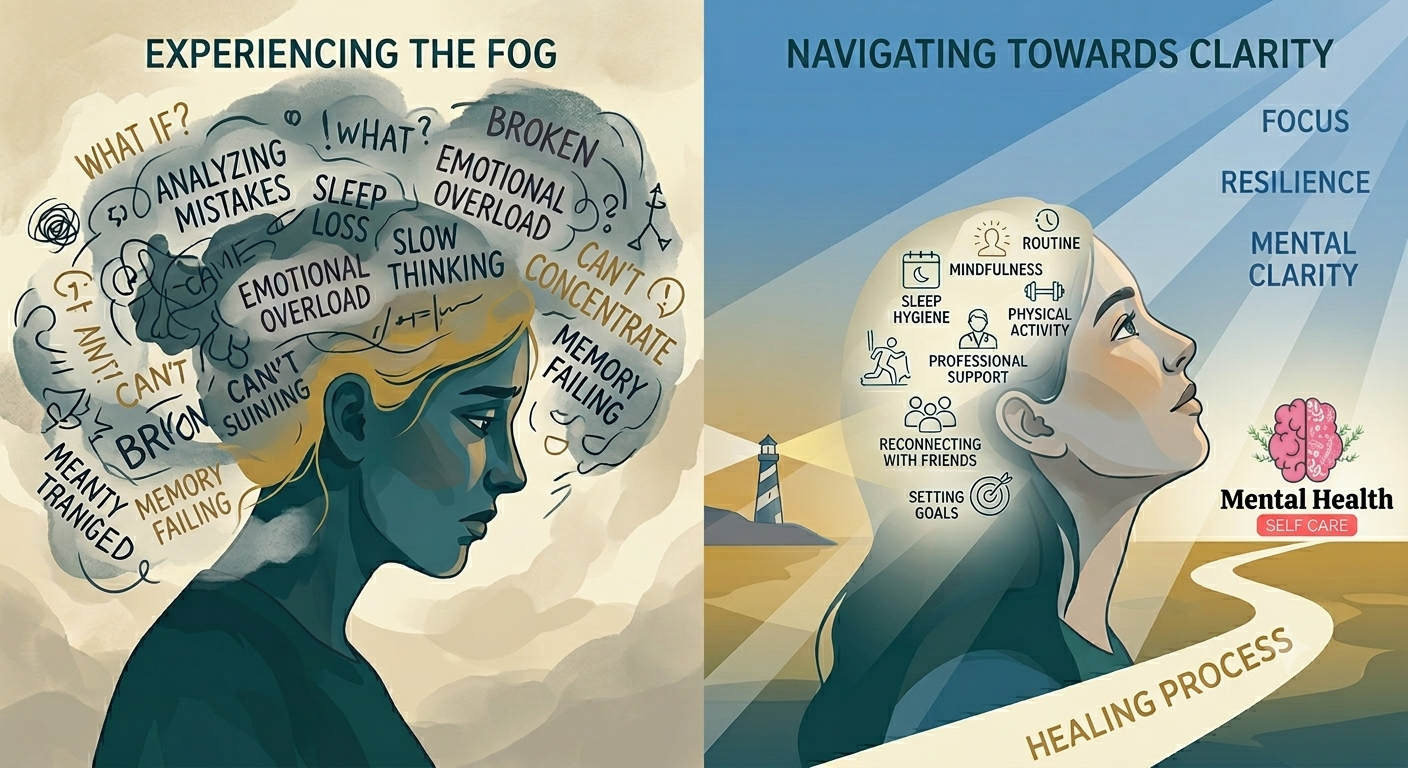
Brain Fog After Heartbreak is a mental fog, lack of concentration, forgetfulness, and mental exhaustion that many individuals feel following a loss of their feelings.
People usually refer to it as:
- Feeling mentally slow
- Difficulty concentrating
- Forgetting simple things
- Trouble making decisions
- Constant mental distraction
Though this response may seem frightening, it is usually linked to the way the brain copes with emotional stress and grief.
Why Heartbreak Affects the Brain So Deeply
Emotional pain does not pass through the brain as light-heartedly as many individuals think.
Once a significant relationship is over, the brain suffers:
- Emotional shock
- Stress overload
- Deprivation of emotional security
- Increased emotional uncertainty
This leads to the heavy concentration of mental resources in processing the emotional event and less energy left to focus, memory and concentration.
It is one of the largest causes of Brain Fog After Heartbreak.
How Brain Fog After Heartbreak Affects Daily Life
Heartbreak does not just influence feelings. It has an effect on the way the brain operates during the day.
Concentration Becomes Extremely Difficult
Less concentration is one of the most frequent symptoms of Brain Fog After Heartbreak. Things which once seemed easy now demand a lot more work. It becomes challenging to read, work, study or even follow conversations as the mind continues to run back to the emotional thought and feelings.
Overthinking Consumes Mental Energy
Once heartbroken, the brain is usually caught in a loop of thoughts.
- Replaying conversations
- Analyzing mistakes
- Wondering what went wrong
- Imagining different outcomes
Such mental activity is always going on, and it takes up cognitive energy and is a substantial cause of Brain Fog After Heartbreak.
Memory and Recall Feel Weaker
Numerous people observe that they forget more after losing someone dear. They might overlook appointments, lose things or have difficulties in recollection of information.
This occurs due to the temporary impairment in brain functioning in processing and storing information effectively as a result of emotional stress.
Decision-Making Becomes Overwhelming
Even minor choices can be mentally fatiguing.
- What to do next
- Where to go
- How to move forward
The brain is already overwhelmed at an emotional level hence making decision making slow and hard.
Motivation and Productivity Drop Significantly
The heart cannot produce much energy when it is broken. With the reduction in emotional energy, mental involvement will also be reduced.
The previously meaningful tasks might be suddenly difficult to complete, which makes frustration and self-criticism more.
Sleep Disruption Makes Mental Fog Worse
Most individuals getting Brain Fog After Heartbreak also have problems with sleep.
- Difficulty falling asleep
- Frequent waking
- Restless sleep
Lack of sleep impairs mental rest, which further exacerbates mental symptoms.
Emotional Triggers Constantly Interrupt Focus
Even songs, places, photos, memories, and conversations may be recalled with an unforeseen emotional response.
Focusing on the present moment is hard since each trigger takes mental attention away.
Daily Life Starts Feeling Mentally Heavier
Basic tasks start demanding efforts beyond the normal. Even without being physically active, people are likely to feel mentally exhausted.
One of the most annoying elements of Brain Fog After Heartbreak is this persistent fatigue.
Signs You Are Experiencing Brain Fog After Heartbreak
Not all people experience brain fog in the same way. Nevertheless, there are some general symptoms that tend to reveal the presence of emotional stress on the functioning of the brain.
You Struggle to Focus on Simple Tasks
Feeling less than usually concentrated.
Your Mind Keeps Returning to the Relationship
Thoughts keep on coming back to memories and unresolved questions.
You Feel Mentally Exhausted Throughout the Day
Even following comparatively light exercise, mental exhaustion manifests itself.
Small Decisions Feel Unnecessarily Difficult
The brain is overwhelmed with decisions and organization.
You Feel Emotionally and Mentally Distracted Constantly
Staying present becomes challenging.
Which Individuals Experience Brain Fog After Heartbreak Most Often?
There are some circumstances and personality types that may exacerbate Brain Fog After Heartbreak.
Individuals Leaving Long-Term Relationships
Prolonged attachment to the emotion tends to cause deeper disruption to the emotion.
People With Strong Emotional Dependence
Heartbreak is more intense when identity becomes super-related to a relation.
Individuals Who Tend to Overthink
Excessive analysis raises mental exhaustion and cognitive overload.
Emotionally Sensitive Individuals
Powerful emotional treatment tends to augment cognitive effect.
People Experiencing Multiple Life Stressors Simultaneously
Symptoms are increased by work pressure, family problems, or financial stress and heartbreak.
How Long Does Brain Fog After Heartbreak Last?
The length of recovery differs with individuals.
The time can usually be based on:
- Relationship length
- Emotional attachment level
- Mental resilience
- Support systems available
- Recovery efforts taken
Initial Emotional Shock Phase (2–6 Weeks)
The initial few weeks are usually the most difficult period of mental confusion.
Cognitive Stabilization Phase (1–3 Months)
Concentration and attention slowly start to get better.
Emotional Recovery Phase (3–6 Months)
The mind is not so preoccupied with relationship-related thoughts.
Long-Term Growth and Mental Clarity
The majority of them ultimately resume normal mental activity and emotional stability.
How to Recover From Brain Fog After Heartbreak
It is not merely a matter of waiting time to get over Brain Fog After Heartbreak. Although time is a factor, active recovery enables the brain to recover quicker and resume its focus, clear thinking and normal functioning capabilities.
It is not to push oneself to keep on moving.
The idea is to enable your mind to recover emotional pain without getting stuck in it.
Through proper intervention, the majority of individuals will eventually come to their senses, emotionally and save confidence.
Allow Yourself to Feel the Pain Instead of Suppressing It
Pretending to be okay when one is not okay, is one of the biggest mistakes which people commit after a breakup. Replacing sadness, disappointment, anger and grief with suppression makes the brain continue processing such emotions in the background.
The greater the disregard of emotions, the more Brain Fog After Heartbreak is likely to last.
Being able to admit your feelings of pain will lower the mental pressure inside yourself and can lead to a healthier recovery.
Stop Replaying the Relationship Repeatedly
Many spend hours in reviewing in their minds:
- Old conversations
- Past memories
- Mistakes made
- “What if” scenarios
Although occasional reflection is normal, continuously ruminating overloads the brain and inhibits emotional healing.
The lessening of repetition in thinking provides the mind with the increase of space to concentrate on the current in lieu of being stuck on the past.
Rebuild a Structured Daily Routine
Broken hearts tend to interfere with regular lives. Routines on sleep, food, work and daily routines become irregular.
The establishment of order is useful in returning the mind to sanity.
- Get up at regular hours
- Adhere to a routine
- Entire small attainable tasks
- Remain busy with constructive things
Using routine makes it more predictable, thereby preventing Brain Fog After Heartbreak over time.
Prioritize Sleep and Mental Recovery
One of the key aspects in cognitive recovery is sleep.
In case the heartbreak influences the sleeping:
- Focus declines
- Memory weakens
- Emotional control decreases
- Mental fatigue increases
Better sleep quality will enable the brain to recover better and minimizes the symptoms of Brain Fog After Heartbreak.
Reduce Emotional Triggers Whenever Possible
The brain is continuously emotionally engaged due to constant reminders.
This may include:
- Frequently going through social media
- Revisiting old messages
- Always viewing photos
- Monitoring an ex-partner’s activities
Forming healthy emotional distance will enable the brain to rest rather than reopening emotional wounds over and over.
Stay Physically Active Even When Motivation Is Low
Exercise helps emotionally and psychologically to heal in strong ways.
Regular movement helps:
- Improve focus
- Reduce stress hormones
- Increase mental clarity
- Improve emotional regulation
Even such minimal activity as walking can be helpful to a great extent in terms of reducing the symptoms of Brain Fog After Heartbreak.
Reconnect With Life Outside the Relationship
Some people make the separation the focus of their whole life, as a result of being heartbroken.
When the focus slowly changes to: the recovery becomes easier.
- Personal growth
- Career goals
- Hobbies and interests
- Family ties and friendships.
This assists the brain to create new emotional experiences rather than being stuck to previous emotional experiences.
Avoid Using Distractions as a Permanent Solution
To get out of emotional pain many people attempt to:
- Overuse of social media
- Constant entertainment
- Overworking
- Unhealthy habits
Distraction in the meantime might do well, but it does not establish healing.
Recovery takes place when the emotional processing and healthy action are combined.
Seek Professional Guidance When Brain Fog Persists
In such a case, when Brain Fog After Heartbreak persists, even in the long-term in its impacts on daily functioning, professional assistance can be of invaluable help.
Systematic instructions assist people:
- Smoothly work with emotional pain
- Reduce overthinking patterns
- Improve emotional regulation
- Feel better after a concussion
Support tends to reduce the recovery period and avoid emotional distress turning into prolonged mental health issues.
Why Choose Mental Health Self Care for Heartbreak Recovery?
Mental Health Self Care assists people to overcome Brain Fog After Heartbreak using systematic support of emotions and mental recovery mechanisms.
500+ Counselling Sessions Supporting Emotional Recovery
People have managed to gain their clarity, trust and emotional balance using well-structured guidance.
5+ Years of Experience Handling Emotional Trauma and Relationship Recovery
Practical recovery approaches are premised on authentic emotional predicaments.
Personalized Recovery Plans Based on Emotional Patterns
Each recovery process is personalized to emotional requirements.
Practical Systems for Reducing Overthinking and Mental Fatigue
Easy tricks assist in enhancing simplicity and emotional stability at all times.
Long-Term Emotional Strength Instead of Temporary Distraction
The emphasis is on sustainable emotional restoration and psychological recuperation.
Conclusion
Brain Fog After Heartbreak is not a sign of weakness.
It is a natural reaction to severe emotional stress and loss.
When a relationship ends, the brain does not simply stop caring overnight. It persists in processing emotions, memories and uncertainty, which in most cases leads to mental fatigue and poor cognitive functions.
The positive aspect is that recovery occurs.
Clarity comes back slowly with patience, good habits, emotional processing and with appropriate support.
Mental Health Self Care assists people to shift confusion, overthinking and emotional exhaustion to stability, focus and emotional healing.
Since heartbreak can result in temporary clouding of the mind, but it should not be your future.