
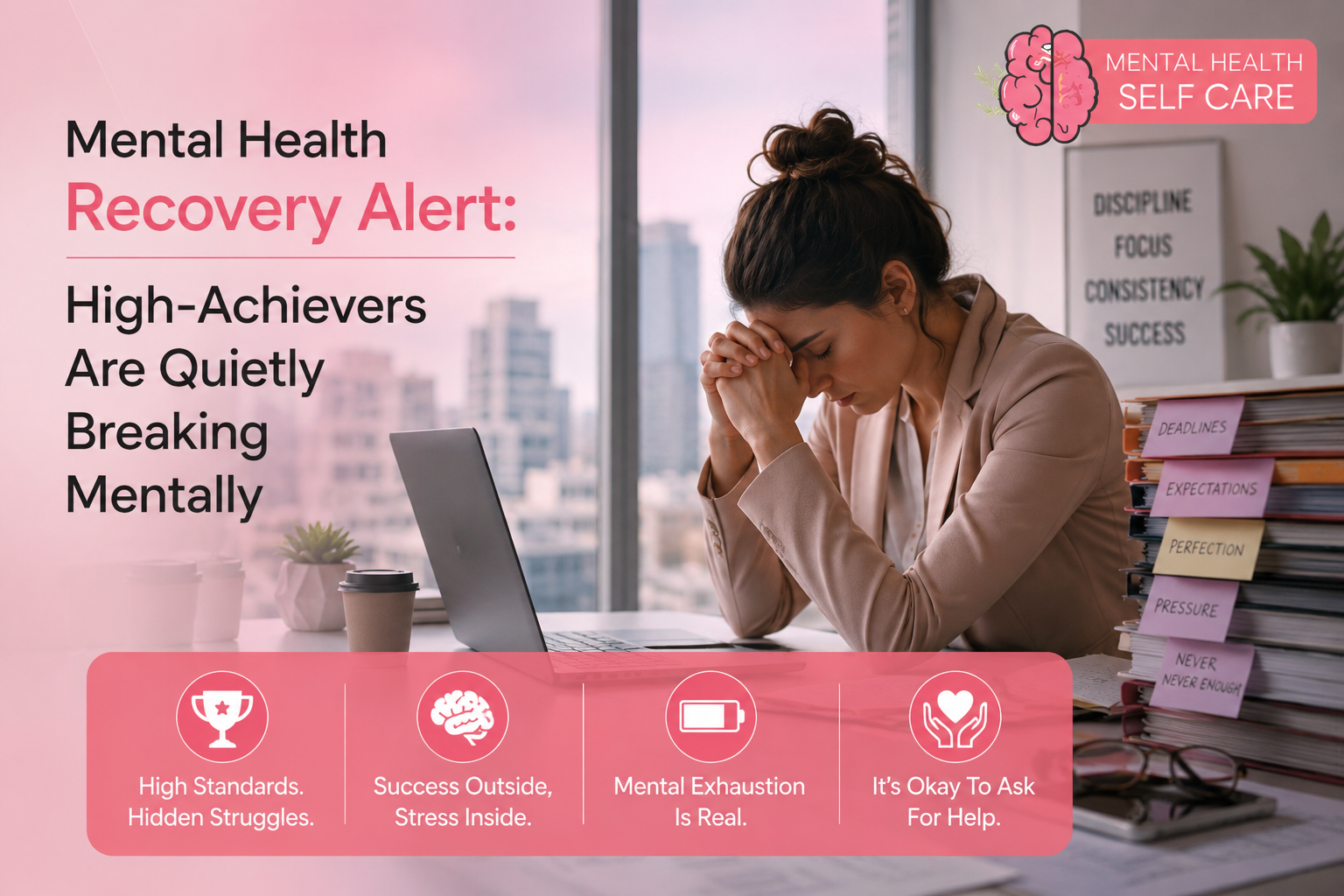
Why do individuals who appear to succeed the most feel the most drained to the core?
They meet targets, stick to schedules, remain productive, and keep on moving. From the outside, they seem to be disciplined and in control. However, behind the scenes, numerous high achievers are in distress.
They are exhausted, emotionally detached, mentally overburdened, and they are continuously pressured to perform. But they hardly ever discuss it since success conceals the hardship.
The complement of high performance surpasses that of mental stability in 2026. People are motivated to do more, work harder, and be present at all times. But behind this culture of productivity, many are simply drifting towards a breaking point.
This is where Mental Health Recovery comes in. Since success without the mind becomes tiring.
What Do You Know About Mental Breakdowns in High-Achievers?
Even high achievers may not appear to be struggling mentally. Most of them keep on working yet they feel overwhelmed internally.
They still:
- Meet deadlines
- Handle responsibilities
- Stay productive
- Maintain appearances
However, internally, they might suffer:
- Emotional exhaustion
- Overthinking
- Constant pressure
- Lack of fulfillment
- Mental fatigue
It is this quiet internal degradation that explains why so many successful people need organized Mental Health Recovery.
Why High-Achievers Are Mentally Struggling More in 2026
In the modern world of success, output is rewarded and not emotional balance.
- Constant competition
- The need to remain relevant
- Fear of slowing down
- Digital overload
- Unrealistic productivity expectations
High-achievers can turn into the trap of resting not being productive and decelerating being risky.
In the long run, this attitude undermines emotional stability and Mental Health Recovery.
How High-Achievement Culture is Leading to Mental Health Recovery
Success itself is not the problem. The issue is the pressure to keep it going.
Self-Worth Becomes Connected to Performance
Most high achievers cease to distance themselves and their success. They are dependent on productivity, results, and validation, which leads to their confidence. As performance declines, so does self-worth. This puts mental strain and emotional instability in an unending state, making Mental Health Recovery the only thing that can provide long-term balance.
Rest Starts Feeling Like Guilt Instead of Recovery
High achievers are usually unable to take their time since they equate rest with lagging. The mind is active even when taking breaks.
- Reflecting on uncompleted tasks
- Remorseful about speeding up
- Constant mental engagement
This does not allow proper recovery and slowly burns out.
Emotional Suppression Becomes a Habit
Successful people usually should remain confident, calm, and goal-oriented. Over time, they cripple emotions rather than work on them.
This emotional accumulation forms the following:
- Internal exhaustion
- Emotional numbness
- Mental fatigue
These trends become entrenched in the absence of a systematized Mental Health Recovery.
Constant Overthinking Replaces Mental Clarity
High-achievers think continuously.
- Planning
- Problem-solving
- Analyzing outcomes
Although this improves performance, it also leads to mental overload. The mind does not get a rest and as a result, there is persistent stress and emotional burnout.
Fear of Failure Creates Hidden Anxiety
The more an individual has attained, the more the fear of losing it.
- Fear of underperforming
- Shyness about letting down others
- Fear of becoming irrelevant
This stress develops silent anxiety that many times is kept under wraps with outward success.
Relationships and Personal Life Start Feeling Emotionally Distant
As in the performance, in which most of the mental energy is involved, the emotional connection is weakened.
- Conversations become surface-level
- Emotional availability reduces
- Relationships feel secondary
This disconnection at the emotional level adds emptiness to success. We understand the career vs family pressure in women’s lives, which is why our founder, Radheshyam More, has covered the pain they go through.
High Functioning Makes the Problem Harder to Detect
The worst risk is that high-achievers will keep on operating.
They still:
- Go to work
- Meet goals
- Stay productive
People think they are okay since they are still performing. This postpones consciousness and retards Mental Health Recovery.
Signs a High-Achiever Is Quietly Breaking Mentally
Constant Fatigue Despite Achievement
Regardless of how much work is done, people feel tired.
Feeling Emotionally Disconnected From Success
Even accomplishments cease to be fulfilling or thrilling.
Difficulty Relaxing Without Guilt
The brain is still active even during breaks.
Increased Irritability and Mental Exhaustion
Even minor problems start to overwhelm the emotions.
Loss of Motivation Despite Strong Discipline
Being able to do it is one thing, but the drive is another thing gone.
Which Individuals Are Most Vulnerable?
There are some personality trends that can predispose one to silent mental breakdown.
Perfectionists With Unrealistic Standards
Imperfection brings about unending internal pressure.
Professionals in High-Pressure Industries
Leaders, entrepreneurs and high performers of corporations are under continuous mental pressure.
Individuals Who Tie Identity to Achievement
Failure is personal when success is identity.
People Who Rarely Express Emotional Struggles
The stifling of emotions leads to inner pressure.
Those Who Constantly Seek Validation Through Success
External validation forms erratic emotional dependency.
Importance of Mental Health Recovery for High-Achievers
Most of the time, high achievers are taught how to build success, but they are seldom taught how to keep their mind in the process of attaining their success.
Over time, daily stress, pressure, and emotional restraint lead to internal fatigue that cannot be cured by success.
This is the reason why Mental Health Recovery will be mandatory to high-performers in 2026.
Prevents Burnout Before It Reaches a Breaking Point
There are several high-achievers who persist in operations when they are mentally fatigued. They disregard stress, power through exhaustion, and make stress and emotional load routine until burnout sets in. Mental Health Recovery ensures that such patterns can be identified early enough, eliminating mental stress before it becomes an emotional breakdown or chronic burnout.
Restores Mental Clarity and Sharp Decision-Making
Due to constant pressure, the mind is overloaded and loses its clarity. Even high-achievers can do so, but their thinking is overloaded, sluggish, and more reactive. Mental Health Recovery is a structured process where the mind is calmed down and organized to enhance the ability of concentration, strategic thinking and making decisions.
Helps Separate Self-Worth From Performance
One of the greatest battles that high achievers face is the one in which they tie identity to success. It makes victory the agent of validation and defeat very personal. Mental Health Recovery helps restore emotional balance by educating people to appreciate themselves beyond productivity and external outcomes.
Improves Emotional Control Under Pressure
High-performance environments create an unceasing degree of emotional tension. Lack of recovery leads to more frustration, irritability, and emotional exhaustion. Mental Health Recovery enhances emotional control and response, which are very difficult to maintain during stressful events.
Creates Sustainable Success Instead of Survival-Based Productivity
Not all successful people are flourishing, but surviving. They work under pressure, adrenaline, and stress rather than on balance. This is not a long-term strategy. Mental Health Recovery assists in developing healthier work patterns in which success no longer comes at the expense of emotional health.
Strengthens Relationships and Emotional Presence
Emotional detachment in relationships occurs as the mind is overcharged. Dynamics are strained, patience is diminished and emotional availability is impaired. Recovery enhances emotional bonding by lowering internal stress and enabling people seem more present in individual relationships.
Reduces Overthinking and Constant Mental Noise
Nonstop thinking is a challenge that high achievers face.
- Planning constantly
- Replaying conversations
- Worrying about outcomes
The noise in the mind consumes energy even when resting. A mental health counselor helps soothe these mental patterns and foster a sense of mental stillness and emotional equilibrium.
Helps High-Achievers Enjoy Success Again
Emotional numbness is one of the least recognized consequences of burnout. Successes do not feel gratifying anymore as the mind is too tired to feel gratified. Recovery helps reconnect people with meaning, enthusiasm, and true gratification in life and work.
Prevents Long-Term Mental and Physical Health Damage
Chronic stress has more than emotional impacts. It affects sleep, activity, concentration and immune system, and physical health. Long-term pressure may have complex mental and physical effects without adequate recovery. Mental Health Recovery safeguards well-being by lessening this internal chronic tension.
Why Choose Mental Health Self Care for Mental Health Recovery?
Mental Health Self-Care is designed to support people who appear immensely strong on the outside but are fatigued in their mental well-being. It is not only about stress reduction but also about assisting high-achievers to get back into clarity, emotional balance, and sustainable performance through structured Mental Health Recovery.
500+ Recovery-Focused Counselling Sessions Successfully Conducted
Hundreds of people have become more emotionally stable, less coiled, and have been able to focus again with well-structured sessions that have been tailored to the needs of the mental workload and its extreme lifestyles.
5+ Years of Experience Handling High-Performance Mental Pressure
It is founded on the life experiences of professionals, entrepreneurs, and high achievers as they have to deal with stress, overthinking, and emotional burnout.
Personalized Mental Health Recovery Plans for High-Achievers
No generic advice. All people are given systematic guidance depending on their mental patterns, pressure points and demands of their lifestyles.
Practical Systems That Fit Into Busy Schedules
Simple mind reset systems, systems of emotional clarity, and stress management systems are designed for real-life use without interfering with productivity.
Long-Term Stability Instead of Temporary Motivation
It does not aim at a momentary alleviation. It is sustainable Mental Health Recovery which assists the individuals to remain mentally well and yet grow both professionally and personally.
Conclusion
High achievers do not shatter mentally because they are weak. They are shattered, having been tough enough for long enough without a rest.
Success can hide exhaustion very well. Yet some form of fatigue is bound to affect clarity, emotions, relationships, and overall life satisfaction.
This is why Mental Health Recovery is no longer a choice for high performers. It is necessary.
A combination of learned recovery techniques and practical mental knowledge can guide people to transcend delusional burnout and achieve a grounded clarity of Mental Health Self-Care.