Why does everything feel heavier after a bad night’s sleep?
Even basic jobs feel challenging. Small problems feel bigger. Your patience drops. Your focus disappears. And your mood feels off for no clear reason.
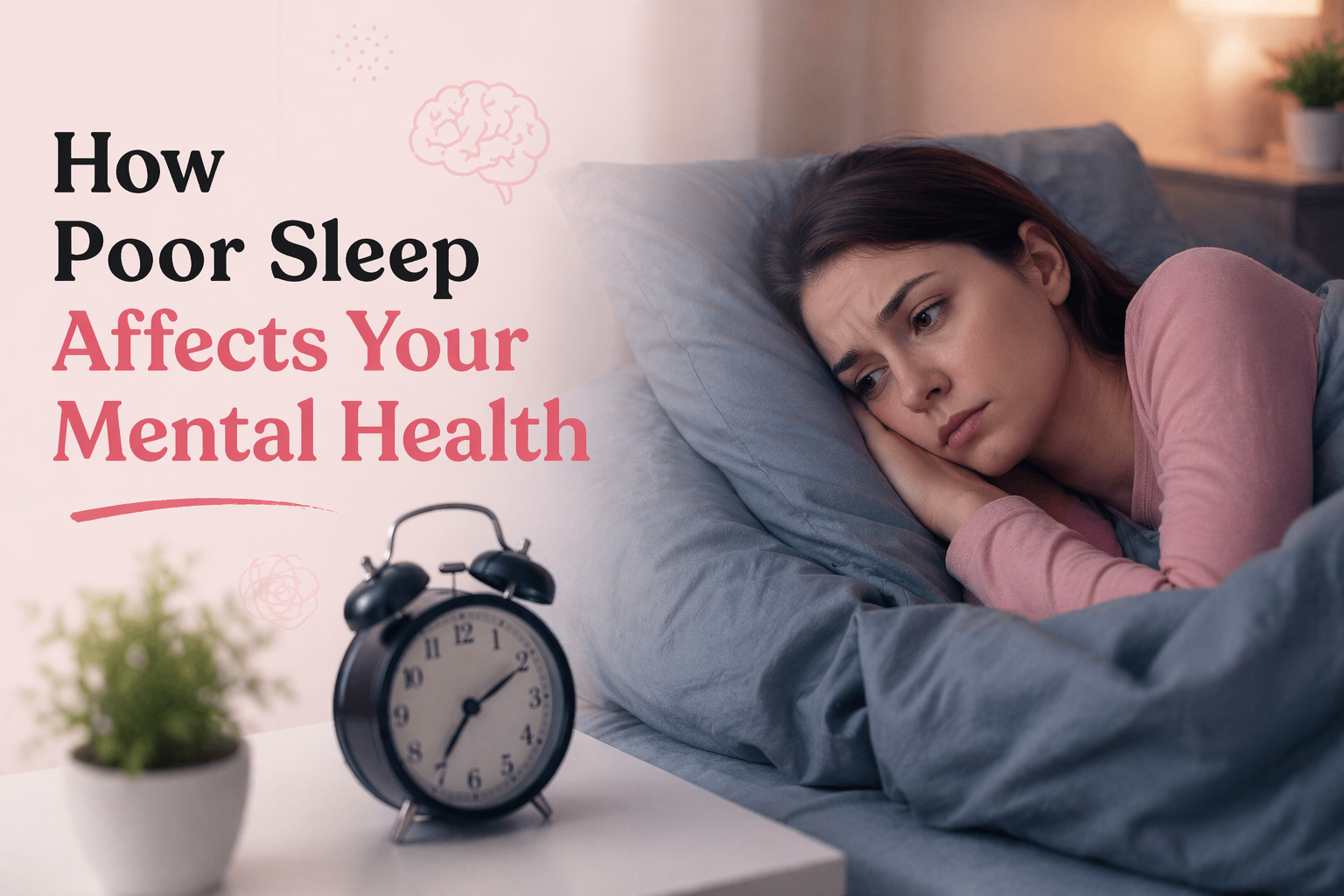
Sleep is not an ordinary body rest. It is mind healing. By 2026, sleep deprivation has become one of the largest contributors to Mental Health without much attention or discussion, yet it is normalized.
Sleep habits are being disturbed by scrolling late at night, unusual times, pressures, and constant stimulation by millions of individuals. It is not merely fatigue. It is psychological instability, loss of clarity and emotional balance.
The thing that more people underestimate is the following:
No matter how tough your Mental Health is, your sleep will be disturbed repeatedly, so your Mental Health will be compromised.
What Do You Know About Sleep and Mental Health?
It is during sleep that your brain takes in information, regulates the emotional state and restores mental activity.
When sleep is good:
- Thoughts feel clearer
- Emotions feel stable
- Focus improves
- Stress becomes manageable
When sleep is poor:
- Thinking becomes slower
- Emotions become reactive
- Stress feels heavier
- Focus drops significantly
This direct relationship demonstrates the close relationship between sleep and Mental Health.
Why Poor Sleep Is Increasing in 2026
The contemporary way of life is geared towards sleep deprivation.
- Too much screen time at bedtime
- Constant mental stimulation
- Stress at work and abnormal working hours
- Overthinking and anxiety
- Absence of regular sleeping patterns
The brain does not have time to relax and this has a direct impact on Mental Health.
Mental health counselling services provide professional support to help individuals manage stress, anxiety, depression, and emotional challenges. Through guided sessions, individuals can better understand their thoughts, improve coping skills, and build a healthier, more balanced mindset for overall well-being.
How Poor Sleep Affects Mental Health
Emotional Stability Becomes Weak and Reactive
A lack of sleep also diminishes your emotional control. Simple situations begin to provoke a larger response. You are more annoyed, impatient or overwhelmed with no significant cause. This occurs due to lack of sufficient brain time to moderate emotional reactions in the course of sleep. This leads to Mental Health instability in the course of time in which your responses are more increased than the circumstance.
Overthinking and Anxiety Increase Rapidly
Insomnia increases the unproductive activity of your mind. Brains do not drag. Rather, they are more repetitive. You begin to worry about such things, which would not bother you. The level of anxiety rises since your brain is already in a stress state. This increases the difficulty in relaxing it and forms a vicious circle where bad sleep and bad Mental Health encourage one another.
Focus and Cognitive Clarity Drop
Sleep has a direct influence on clarity of thinking. When you, then, are not getting enough sleep, your brain will not be able to concentrate, process and make decisions.
- Problem with concentration on activities
- Slower thinking speed
- Increased mistakes
- Mental fog
Such loss of clarity influences productivity and confidence, which are desirable to stable Mental Health.
Stress Feels Heavier Than It Actually Is
When your body is in good sleep you are able to deal with stress. Even minor issues seem daunting when you lack sleep.
Your brain will sense stress differently when you are fatigued:
- Things are more dramatic
- Pressure feels higher
- Coping ability reduces
This increases stress and has a negative influence on Mental Health.
Motivation and Energy Drop Significantly
Sleep deprivation decreases physical and mental energy.
- You are fatigued during the day
- You avoid tasks
- You postpone work of significance
This forms a cycle of low productivity and frustration, which also influences Mental Health.
Emotional Processing Becomes Incomplete
Sleep aids in processing emotions in your brain. Without it, no emotional life will be paid off.
- Feelings linger longer
- Emotional clarity reduces
- Reactions become impulsive
This untidied processing produces internal pressure, which impacts on Mental Health in the long-term.
Risk of Depression and Burnout Increases
Poor sleep, being chronic, is closely associated with severe mental disorders.
- Persistent low mood
- Emotional numbness
- Loss of curiosity in things
This may cause depression and burnout in the long-run, so sleep is one of the most important aspects of Mental Health.
Signs Your Sleep Is Affecting Your Mental Health
- You have frequent fatigue on waking up
- You are annoyed, without clear explanation
- You have difficulty concentrating
- You think more at night
- You have a changeable disposition
These are the initial signs that your Mental Health is being impacted by lack of sleep.
How to Improve Sleep for Better Mental Health
A good sleep does not begin with going to sleep.
It begins with the way you prepare your mind on a daily basis.
The majority of the population attempts to remedy sleep at night, which is already too late. Over-thinking, stress, screen time and inconsistent habits accumulate throughout the day and manifest themselves as you attempt to sleep.
To better your sleeping and keep your Mental Health safe you must have a system that works before, during and after you sleep.
1. Set a Fixed Sleep–Wake Window
Your brain works on patterns. When your circadian clock continues to change in terms of sleep time, it never clears.
- Sleep and wake up at a regular time everyday
- Do not change timings during weekends
- Provide your body with regular beats
This develops internal stability which will contribute to improved Mental Health.
2. Create a 60-Minute “Mental Shutdown” Routine Before Bed
The upper stimulation level cannot be suddenly followed by profound sleep.
- Take a break at least 45-60 minutes before bed
- Do not have heated discussions or choices
- Change to lower-energy, relaxing behaviors
This sleep phase prompts your brain to slow down, enhancing your sleep and Mental Health.
3. Cut Screen Stimulation at the Right Time (Not Just Less, But Timed)
Not only does it concern less time on the screen, but also when you watch screens.
- No screens 30-60 minutes before bedtime
- Limit the amount of short-form content at night
- Employ your phone, not aimlessly
This will help you to be less mind-stimulated and keep your Mental Health uncongested.
4. Clear Your Thoughts Before You Lie Down
The majority of individuals spend their whole day in bed.
- Note down outstanding tasks
- Record ideas or concerns
- Mentally “close” your day
This does not allow your brain to work through everything at night, which enhances sleep and lends stability to Mental Health.
5. Use Breathing to Slow Your Nervous System
The state of your mind depends on the way you breathe.
Before going to sleep:
- Inhale for 4 seconds
- Hold for 4 seconds
- Exhale for 6 seconds
- Repeat for 3–5 minutes
This eliminates anxiety, slows your thoughts and promotes better Mental Health.
6. Keep Your Sleep Environment Mentally Calm, Not Just Physically Comfortable
Your room influences your mind even more than you think.
- Dim lighting
- Minimal noise
- Uncontaminated and uncluttered space
A stress-free atmosphere will inform your brain to ease up, enhance sleep and Mental Health.
7. Avoid Late-Night Overthinking Triggers
Some habits augment night-time cognitions.
- Serious nocturnal deliberations
- Overanalyzing your day
- Doing all the planning in advance
Move these activities early in the morning to safeguard your Mental Health at night.
8. Stay Physically Active During the Day
Having a body at rest gives the business of the world to the mind.
Move, exercise or walk daily.
It is better not to sit the entire day without breaks.
Exercises can be used to relieve accumulated stress and sleep better, which benefits all Mental Health.
9. Limit Caffeine and Heavy Stimulation in the Evening
What you eat influences the way you sleep.
- Do not take caffeine late in the afternoon
- Eliminate high fructose meals before going to bed
- Much hydration but no overload at night
This assists your mind and body to relax.
10. Build a Repeatable Night Pattern (Consistency Over Perfection)
Your brain is fond of repetitions.
- Stick to the same pre-sleep routine everyday
- Make your nights routine
- Do not seek ideal sleep, develop regular sleep
Such consistency enhances your Mental Health in the long run.
Why Choose Mental Health Self Care?
A majority of sleep problems are not sleep problems.
They are mental health issues that manifest themselves in the night.
Thou sleorest but thy thoughts not.
You’re tired, but your mind is still active.
This is why simple tips do not work. Since it is not only an ordinary matter, it is your Mental Health patterns.
Mental Health self care is developed in such a way that it addresses that in its core.
1. Night-Time Mind Control System That Actually Slows Your Thoughts
Instead of instructing you to relax, Mental Health Self Care demonstrates to you how to slow down your mind when it counts.
- Determine the reason why you think most at night
- Interrupts thinking patterns
- Train your mind to turn off, rather than to remain on alert
This not only stabilizes your Mental Health directly, but it also enhances sleep naturally.
2. Personalized Sleep Psychology Mapping (Not Generic Advice)
There is no common cause of insomnia among two individuals.
- Some overthink
- Some feel anxious
- Others remain cognitively alert.
Mental Health Self Care maps your unique mental triggers, and develops a plan based on them.
This causes the enhancement of Mental Health to be more relevant.
3. Short, Focused Sessions That Clear Your Mind — Not Fill It
Long discussions are not a good idea when you already have too much in your mind.
- General, hard 30-60 minute sessions
- No unnecessary theory
- Clear point of view as to what to change
Each of the sessions helps to minimize confusion and enhance your Mental Health stability.
4. Simple Night Reset Practices You Can Do in Under 15 Minutes
You do not require lengthy exercises. You require good ones.
- Quick thought-release methods
- Relaxing breathing exercises
- Night relaxation methods
Such tasks directly decrease night-time overthinking and enhance Mental Health balance.
5. Fixes the Root Cause Behind Disturbed Sleep
The majority of individuals attempt to correct sleep on the outside.
Mental Health Self Care is an in-house company.
- Emotional overload
- Stress accumulation
- Unresolved mental loops
- Constant cognitive stimulation
Once they are managed, then you find yourself getting better Mental Health and then sleep just follows.
6. Noticeable Shift in 2–4 Weeks (Not Endless Waiting)
It is not a process that is vaguely perceived.
With consistency, people typically experience:
- Less night-time rumination in 2-3 weeks
- Faster sleep onset
- Better emotional calmness
- Improved next-day clarity
This is actual Mental Health improvement.
7. Builds a Mind That Stays Calm Even Under Pressure
Better sleep is not the only purpose.
The aim is a non-spiraling mind.
Mental Health Self Care supports you:
- Learn to manage stress without taking it to bed
- Be clear on high pressure days
- Before cycling, avoid excessive thinking
This does not only provide temporary relief but long-term control on your Mental Health.
Conclusion
Sleep deprivation is not a physical problem only. It is a mental one.
It influences your thinking, feeling and reactions to life. In the long run, it may undermine your capability to remain relaxed, alert, as well as emotionally stable.
The positive thing is that sleep is also among the most manageable aspects. Even minor modifications in habits can produce major differences in both sleep and Mental Health.
Because when your mind is well-rested,
everything else becomes easier to manage.