Have you ever shut a social media application and felt worse than you were before opening it?
Not every time, but with sufficient frequency to observe. You read to rest, and find yourself contrasting. You open it to pass the time, and forget hours. You seek unity, yet are oddly out of harmony.
That is the paradox of 2026.
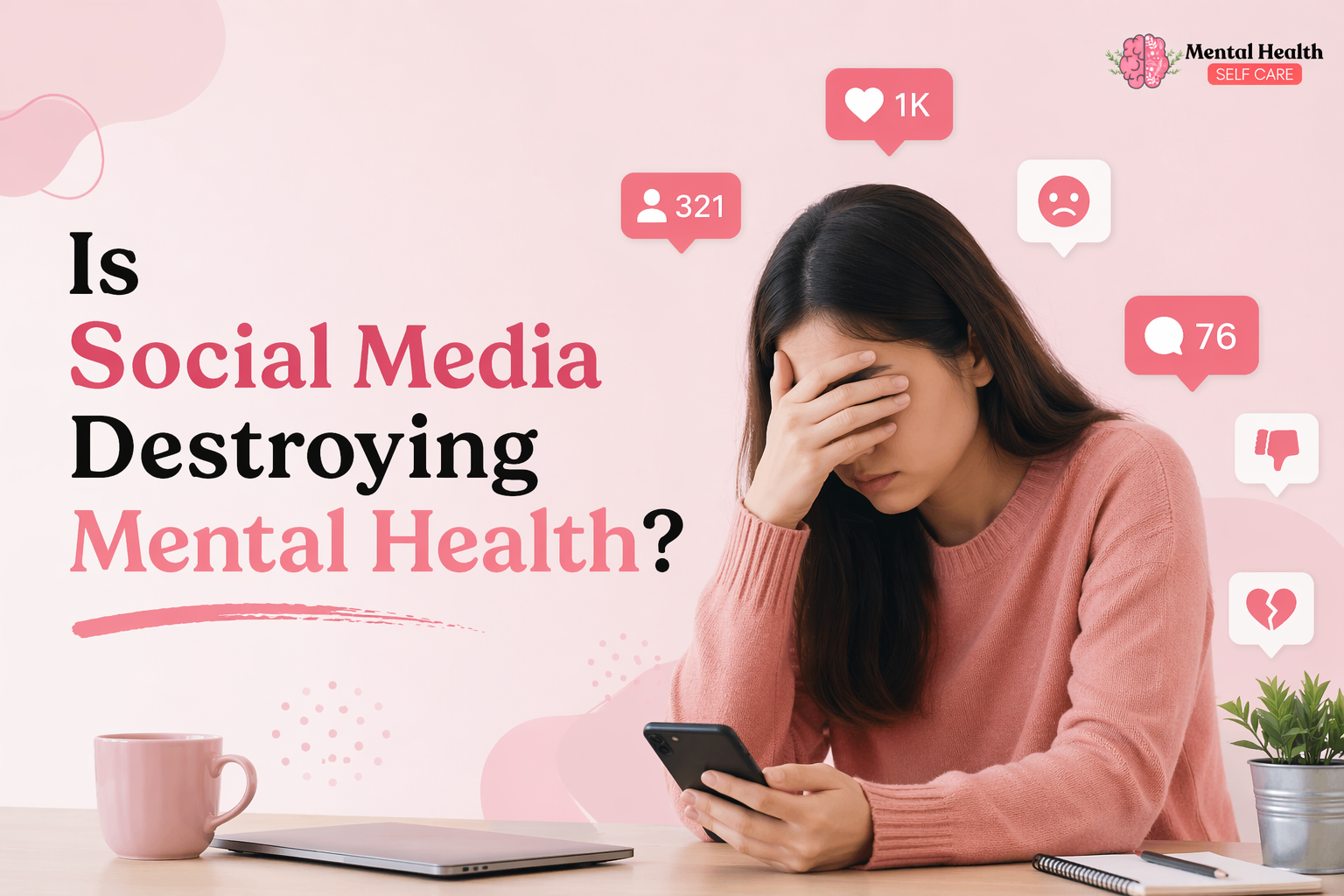
Social media was created to bring people together, yet for many people, it is quietly influencing mental health in ways that are not immediately obvious—social media can destroy mental health over time. It doesn’t happen all at once; it builds gradually through habits, comparisons, overstimulation, and continuous exposure.
The real question here is:
Is it that social media is in fact ruining Mental Health, or rather is it merely our usage that is the issue?
We will decompose it.
What Do You Know About Social Media and Mental Health?
Social media itself is not bad. It is destructive when the use patterns change to compulsive.
It impacts on Mental Health by:
- Constant comparison
- Information overload
- Reduced attention span
- Emotional need of validation
- Deficiency of actual rest of mind
It is not the platform that is the problem.
The issue is the unregulated consumption trend.
Why Social Media Feels Addictive in 2026
Social media is created to capture your attention.
- Infinite scrolling
- Short-form content
- Notifications and rewards
- Algorithm-driven personalization
All this forms a dopamine circuit.
- You scroll → stimulation is received / feel good / repeat.
In the long term, this influences your Mental Health, making your mind hyperactive, more dependent and restless.
How Social Media Is Affecting Mental Health
Mental Health is not hurt by social media in an obvious manner. It is a slow process, based on recurring exposure, subtle comparisons and continuous stimulation.
Until their way of thinking, concentration, and emotional mood begin to alter, most individuals are unaware of the transition. Now, we shall divide up this way in practice.
Constant Comparison Is Rewiring Self-Perception
Social media puts you in this cycle where you are constantly shown with the highlights of other people. Promotions, holidays, body-shaping, affairs, all seem to be smooth and flawless. Although you may not be making a conscious comparison, your mind begins to make comparisons on how your life is compared to the one you see.
This will lead to silent discontent as time passes and you start to feel like you are falling behind, yet you are doing well. This constant comparison dilutes mental health, demeaning self worth and developing self doubt.
Mental Overload Is Increasing Thought Noise
With each scroll, you are bombarded with dozens of opinions, ideas, updates and emotions. All of that is processed in your brain, although it may not be clear. This will result in the clutter of the mind, when your mind is never clear and is in motion.
You begin to overthink, think less and have trouble organizing your thoughts. This excessive strain directly affects Mental Health, which becomes more difficult to remain calm, focused, and mentally stable during the day.
Attention Span Is Getting Shorter and Weaker
Short-form content condition your brain to find fast rewards. Videos are lesser, content is quicker and all is meant to attract attention immediately. As a result, your brain loses the ability to stay focused on one task for a long time.
You begin to alternate between applications, activities, and ideas more. This impairs your concentration capacity, productivity and frustrates you, which in the long run will have a bad impact on Mental Health.
Emotional Dependence on Validation Is Growing
Likes, comments and views have ceased to be features; they are now emotional triggers. When interaction is strong, you are happy. When it’s low, you question yourself. This results in an addiction that causes you to be affected by your external responses.
This undermines your inner stability and causes you to depend on other people to get you validated. This change directly affects Mental Health, causing emotional ups and downs that can hardly be controlled.
Sleep Patterns Are Quietly Getting Disrupted
It is now normal to scroll late at night but it comes at a cost. Your brain is continuously stimulated and this is not supposed to happen at an age that requires the brain to slow down. This postpones sleep, deteriorates the quality of sleep and denies the mind time to recover.
This lack of sleep in turn causes irritability, lack of energy and heightened stress the following day. This is an ongoing cycle which is slowly influencing Mental health in a manner that feels like a norm but is in fact detrimental.
Unrealistic Expectations Are Changing Reality Perception
Success in social media can be made out to seem quick, simple, and painless. The results without the process are what you can see. This poses unrealistic life, career, relationship, and personal development expectations.
Frustration arises when real life is not in line with this version. You begin to doubt your development and have a sense of stagnation. This disjunction between hope and reality may be greatly troubling of Mental Health, resulting in discontent and stress.
Reduced Real-Life Interaction Is Affecting Emotional Depth
Although social media enhances bondage in the digital realm, it does not always bring about good in-person communication. Discussions are more brief, divided and lack depth. This causes feelings of loneliness after some time despite being linked with numerous individuals online. This absence of authentic attachment affects Mental Health and causes individuals to feel lonely even though they are always connected.
Is Social Media Completely Bad for Mental Health?
No. And this is significant.
Mental Health can also be helped by social media when properly utilized.
Positive Uses:
- Learning and awareness
- Getting in touch with other like-minded individuals
- Availability of useful materials
- Community support
Its difference lies in its usage.
Signs Social Media Is Affecting Your Mental Health
You do not have to be diagnosed. You need awareness.
- You feel worse having scrolled
- You put yourself to frequent comparisons
- You lose time so comfortableably
- You have difficulties with concentration on tasks
- You are not comfortable with not having your phone
These are the initial symptoms that your Mental Health is becoming impacted.
How to Use Social Media Without Damaging Mental Health
Social media is here to stay. The idea of removing all apps is not a viable option to the majority of the population. The actual aim is to have it without its control over your mind.
Delinquency versus healthy use is easy:
Do you actively use social media or is it actively using you?
Below is an effective system to safeguard your Mental Health and remain connected.
1. Set a Clear Daily Time Limit (Non-Negotiable)
When you do not specify how you will use it, then it will grow on its own.
- Restrict to 30-60 minutes/day
- Use application timers as required
- Do not have the habit of simply checking
This sets limits and discourages unconscious scrolling that is damaging to Mental Health.
2. Never Start or End Your Day With Social Media
The initial and the final hour of your day conditions your psyche.
- Do not scroll as soon as you get up
- Avoid social media before going to sleep
Why it matters:
- Morning use establishes comparison and distraction
- Your brain is overstimulated with night use
Having positive consequences on your Mental Health alone is a great benefit of securing these two windows.
3. Clean Your Feed Aggressively
The feed which is in your mind is your mental environment.
- Unfollow profiles that evoke comparison or negativity
- Eliminate time wasters
- Adhere to value-added or understandable content
What you think about is what you see. Having a curated feed keeps your Mental Health safe.
4. Shift From Passive Scrolling to Intentional Usage
The majority of harm is the result of careless scrolling.
Rather, employ social media with intent:
- Learning something specific
- Connecting with someone
- Posting and logging off
Avoid endless browsing. Cognitive load is minimized and helps to achieve better Mental Health when intentional use is applied.
5. Avoid Short-Form Content Overload
The largest attention distractors are short videos.
- Limit reels/shorts consumption
- Avoid binge-watching
- Substitute with longer, meaningful contents
Too much short-form content trains your brain to lose focus, directly affecting Mental Health.
6. Take Weekly Digital Detox Breaks
Your brain requires being unstimulated.
- Have 1 full day off in a week
- Or at least 6-8 hours without social media
- This refreshes your brain and decreases addiction
7. Don’t Compare Your Reality With Someone Else’s Highlight
Social media portrays life edited versions.
- Individuals share victories and not difficulties
- Results, not process, you see
Remind yourself:
- What you observe is not all reality
- The evaluation is made on partial data
This mindfulness safeguards your Mental Health against undue stresses.
8. Turn Off Non-Essential Notifications
Alerts constantly draw your attention.
- Disable unnecessary alerts
- Check applications periodically
This decreases distractions and makes your mind less tense.
9. Replace Idle Scrolling With Better Habits
The majority of scrolling occurs when you are bored.
Rather than going to default to your phone:
- Read a book
- Go for a walk
- Work on a skill
The most important thing to safeguard your Mental Health is to replace the habit.
10. Track How You Feel After Using Social Media
This is the easiest-to-use tool of awareness.
Ask yourself:
Have I improved or not after using it?
Do I feel relaxed or fatigued?
Your response will inform you on whether your usage is healthy or not.
The Role of Dopamine in Social Media Usage
Your brain becomes conditioned by social media to find a quick reward.
- Short videos
- Instant likes
- Continuous novelty
This lowers your concentration to more substantial tasks.
It is vital to repair this to safeguard your Mental Health.
Why Most People Struggle to Control Social Media
Not being disciplined. It’s conditioning.
- Habit loops
- Environmental triggers
- Easy accessibility
This realization needs to be broken.
Why Choose Mental Health Self Care?
By 2026, the majority of the people are already aware of what is impacting their Mental Health.
They are aware that they are overthinking. They are aware that social media is consuming them. They are aware of accumulating stress.
And being acquainted is not the issue.
The lack of a systematic approach to remedy it.
This is precisely the point where Mental Health Self Care comes in. It is not a motivator. There is no chance for counsel. It is an incremental process system of mental change that is supposed to assist you to get your mind under control, decrease mental loads and restructure clarity in such a manner that it actually fits your life.
1. 3-Phase Mental Reset System (30–90 Days Clear Transformation Path)
Mental Health Self Care will not keep you wondering what to do.
- Phase 1 (Weeks 13): Find mental patterns and decrease overload
- Phase 2 (Weeks 4-8): Develop concentration, emotional regulation, and clarity
- Phase 3 (Weeks 9-12): Become stable and form long-term discipline
The systematized methodology will make sure that your Mental Health is enhanced step-by-step, instead of by chance.
2. 100% One-on-One Sessions Focused on Your Reality
Your Mental Health and issues are not a one-fit-all-size-fits-all-problem and so should not be your solution.
- Tailor-made sessions according to your specific triggers
- No un-group discussion and superficial chatter
- Take a profound look at thought patterns, habits, and behavior
- Safe, judgment-free environment
It is this degree of personalization that brings about actual, quantifiable change.
3. 30–60 Minute High-Impact Sessions Without Mental Overload
The unstructured and long conversations tend to confuse people rather than illuminate them.
Mental Health Self Care offers:
- 30, 45, and 60-minute intensive lessons
- Precise guidance within each session
- Actionable insights, not theory
- Basic models you can put into practice
Each session will help to make your thinking easier and build your Mental Health.
4. Under-15-Minute Daily Mental Reset Tools
You do not have to spend hours practicing. You need consistency.
- 10-15 minutes of clarity self-comes in a day
- Interruption of thoughts and focus-building techniques
- Emotional regulation practices
- Stress reset routines
These applications will assist you to manage your Mental Health not just in session but also in real time.
5. 70% Focus on Root Cause, Not Just Symptoms
The vast majority of interventions attempt to decrease such symptoms as stress or anxiety.
Mental Health Self Care is more.
- Recognizes covert triggers of thoughts
- Breaks repetitive mental patterns
- Lessons pressure and demands within an organization
- Rewires behavioral loops
With the root cause being tackled, your Mental Health gains automatically and in a sustainable manner.
6. Noticeable Results Within 3–4 Weeks
This is no protracted, indefinite process.
Regularly, most people, experience:
- Less overthinking in 2-3 weeks
- Improved focus and decision-making
- Better emotional stability
- Reduced stress and cognitive stress
Your Mental Health doesn’t just feel better. It gets less wild and uncontrolled.
7. Designed for Real Life, Not Ideal Conditions
You do not have to alter your whole life to begin with.
- Flexible working schedules to working professionals
- Activities centered around your everyday life
- Down to earth methods that can work into schedules
This will help you remain consistent and safeguard your Mental Health uninterrupted.
8. Long-Term Stability and Relapse Prevention
Temporary relief is easy. Long-term control is rare.
Mental Health Self Care helps you:
- Be aware of the symptoms of mental overload
- Handle stress without breakdown
- Stay focused when under stress
- Develop good mental boundaries
This guarantees that your Mental Health is still stable even after the program.
Conclusion
Social media is not the enemy.
Uncontrolled usage is.
Left unchecked, it can quietly affect your Mental Health, your focus, your confidence, and your emotional stability. But when used intentionally, it can become a tool instead of a problem.
The key is awareness, control, and structure.
When you believe that your Mental Health is being impacted, do not ignore it.
Because in a world designed to capture your attention,
protecting your mind is your responsibility.