The reason is that your body is still restless even when you are trying to relax.
You are going to sit down to take a rest, yet your mind does not stop. The location of your chest tightens, your mind is racing and your body remains at alert. Stress and anxiety do not necessarily reside in the mind. They present themselves in the body; in tension, exhaustion, shallow breathing, and restlessness.
In 2026, individuals are as mentally saturated as they have never been before. The pressure of work, the distracting presence of computers and other digital devices, emotions, and the inability to move make the body seem to be in a cycle in which it does not even relax in the end. The mind makes this as the body does not shed out accumulated stress.
This is where it comes in sometimes the mind can be most relaxed when people think less. Calming it you move the body in a different manner.
There, physical activities are made strong. They are useful to get the tension out of your system, manage your breath, feel better, and restore harmony to your system. By doing it regularly, they do not only alleviate stress, but they restore your wellbeing after stress and anxiety in a sustainable condition.
What Do You Know About Physical Movement and Mental Health?
The connection is simple. When the body is active in the right direction then the mind too is in line with it.
Physical exercises can be used to get over stress and anxiety in that they:
- Getting rid of accumulating physical strain
- Enhancing blood circulation
- Managing the breathing modes
- Reducing stress hormones
- Raising positivity chemicals such as endorphins
It is aimed not at hard exercises. Your system is soothing with some good intentions.
How Physical Activities Help You Recover from Stress and Anxiety
The stress is accumulated as there is no outlet of energy. This results in anxiety in the case of the body staying in a state of alertness.
Movement breaks this cycle.
- It brings a change of focus into action
- It brings you down to the here and now
- It dissipates repressed nervousness
- It enhances emotional stability and sleep
That is why regular exercise is one of the most effective means to get over stress and anxiety.
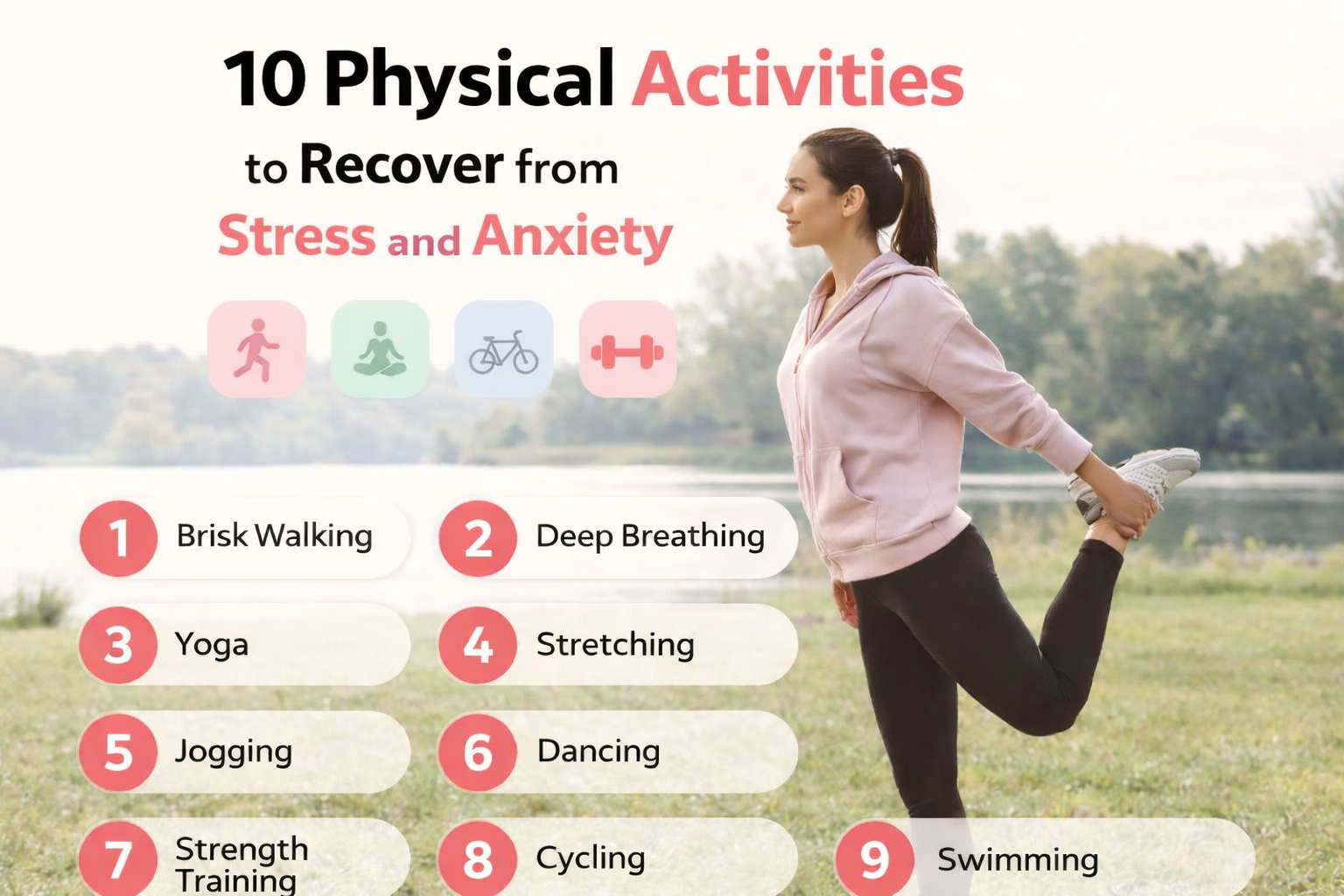
10 Physical Activities to Recover from Stress and Anxiety
You do not simply keep stress and anxiety in your mind. They occupy your shoulders, your breathing, your posture and your energy level.
This is the reason why you cannot always think your way out. You have to move your way out.
The correct type of movement is known to make your nervous system take a breather, relieve some of your stress and get your body to a relaxed position. These exercises will put you in the real state of being de-stressed and less anxious, rather than simply avoiding stress, as performed on a regular basis.
These are 10 of the most effective and actual activities that really do make a difference.
1. Brisk Walking (20–30 Minutes Daily)
The most underrated mental re-set is walking.
- Clears mental clutter
- Increases blood flow to the brain
- Reduces stress hormones
- Helps systematize disordered thoughts
You don’t need intensity. You need rhythm. A slow walk everyday would enable you to regain stress and anxiety and not overburden your system.
2. Deep Breathing + Slow Movement
Your breaths are superficial when you are in a state of stress. This would keep your body in an alert state.
- Breath deeply via noses
- Take the breath out gradually through the mouth
- Add on low intensity walking or stretching
This soothes your nervous system and takes a rapid effect in depleting the level of anxiety.
3. Yoga for Nervous System Reset
Yoga is among the best methods that can be used to create a balance between the mind and body.
- Reduces muscle tension
- Enhances breathing pattern
- Enhances emotional control
- Creates mental stillness
Yoga can also be of great assistance even if it is 20 minutes of the yoga to take you out of stress and anxiety with time.
4. Stretching to Release Stored Tension
The stress accumulates physically particularly in the neck, shoulders and the back.
- Simple full-body stretches
- Focus on tight areas
- Slow, controlled movements
This assists in the release of a tension which has been accumulated, and also relaxes in the short term.
5. Light Jogging or Running
In case you feel that something is not right in your mind, you may need your body to expel the energy.
- Burns excess nervous energy
- Enhances mood by endorphin
- Clears mental fog
Even 10-15 minute short runs might help you get going more quickly than just being there.
6. Dancing for Emotional Release
Stress does not always make sense. It’s emotional. And feelings have to be put across.
- Play music and move freely
- No structure, no rules
- Dwelling on fun, rather than results
Dancing can be used to relieve emotions and it has been noted as being one of the most natural methods of getting to recover after stress and anxiety.
7. Strength Training for Mental Control
Basic strength training does not only create muscles.
- Improves confidence
- Enhances discipline of the mind
- Soothes anxiousness-induced agitation
Your energy and mood can be balanced and resisted using squats, push-ups, or resistance training.
8. Cycling for Mental Refresh and Escape
Biking is a combination of a change of surroundings and movement.
- Cardiovascular improvement
- Gives a sense of freedom
- Reduces mental fatigue
It even comes in handy when one is spiritually stagnant.
9. Swimming for Deep Relaxation
Water has some natural appeal to the body.
- Relaxes muscles
- Regulates breathing
- Alleviates stress, physical and mental
One of the best ways of bouncing back to life after being stressed or anxious is to engage in swimming as one of the most effective full body exercises.
10. Mindful Walking (Walking Without Distraction)
This contrasts with normal walking. It’s about awareness.
- Focus on each step
- Notice your surroundings
- Be in the moment, and do not look at the future
This minimizes over thinking and conditions your brain to slow down.
How Often Should You Practice These Activities?
This is one of the greatest mistakes that people perform, they work excessively in the initial stages and then quit altogether. Consistency, rather than intensity, is far more important as far as movement and mental health are concerned. The idea is to create a rhythm that can be maintained by your body and mind to enable you to ease out of stress and anxiety gradually without fatigue.
We should actually deconstruct it in a manner that works in real life.
1. If You’re Just Starting (Beginner Level)
Frequency Recommendation: 15-20 minutes per day.
At this point, performance is not the matter. It’s activation.
- Light walking
- Basic stretching
- Movement with simple breathing
What to aim for:
- Exercise (even do a little) on a daily basis
- Always remember to keep it simple otherwise there may be resistance
What improves:
- Reduced restlessness
- Slight mental calmness
- Better sleep initiation
This phase assists your system to begin to adjust and therefore to be slowly back to your feet after the stress and the worry.
2. When You Start Feeling Slightly Better (Moderate Level)
Suggested Frequency: 25-30 minutes, 4-5 times per week.
The body is now more responsive and you are able to go a bit longer.
- Walking + light jogging
- Yoga sessions
- Cycling or basic workouts
What to focus on:
- Combining 2-3 activities throughout the week
- Being consistent rather than working harder
What improves:
- Better emotional balance
- Increased energy levels
- Reduced anxiety intensity
It is upon this that visible improvement can be first realized.
3. When You Want Long-Term Stability (Advanced Consistency Level)
Frequency Recommended 30-45 minutes, 5-6 days a week.
At this, the movement becomes a kind of your way of living.
- Strength, cardio and relaxation exercises are combined
- Regular outdoor movement
- The variation of a week to prevent sameness
What to focus on:
- Uniformity rather than perfection
- No pushing, listening to your body
What improves:
- Stable mood
- Stronger mental clarity
- Managing stress in everyday life
It is the way to recover under stress and anxiety in a sustainable way.
4. Weekly Structure That Works Practically
You do not need to think too hard about everyday planning, just make it plain:
- 3 days: Intense exercise (walking, jogging, cycling)
- 2 days: Mind-body (yoga, stretching, breathing) activities
- 1 day: Light exercise or rest (slow walk, rest)
- 1 day: Free rest or slight movement
This equilibrium helps to avoid physical and mental burnouts.
5. What Matters More Than Frequency
It is not all about the frequency of moves. It’s about how you approach it.
- No more than one or two days off
- Pay not by overcompensating in the future
- No, don’t consider it something to do, it is a reset
It can be applied even 15 minutes a day, which is better than 2 hours a week.
6. Signs You’re Practicing at the Right Frequency
You don’t need a tracker. Your body will tell you.
- You are a little more relaxed with exercise
- Your ideas are so less intense
- Sleep improves gradually
Energy is more stable in the daytime.
When you are feeling drained rather than restful, ease rather than work hard.
When Physical Activities Alone Are Not Enough
The other times, the stress and anxiety do not go all the way as far as physical release.
Additional support is necessary when:
- Anxiety feels constant
- Sleep is affected
- Ideas are uncontrollable
- Daily life is impacted
Mentally aiding movement produces superior results.
Why Choose Mental Health Self Care for Stress and Anxiety Support?
In this case, stress and anxiety do not simply disappear because of a lack of activity and being distracted. They decrease by knowing what is causing them, what your mind is responding to and how to get it back to a steady position. Mental Health Self Care is specifically built to do so, providing well-organized and practical assistance that will allow you to overcome stress and anxiety in a controlled, and long-term manner.
This is not superficial motivation. This is directed psycho-restructuring.
1. 3-Phase Stress & Anxiety Recovery Framework (30–90 Day Model)
Mental Health Self Care has a well structured progression model such that you are not lost in the process.
- Phase 1 (Weeks 13): Triggers and mental overload identification and minimization.
- Phase 2 (Weeks 4 -8): Establish emotional control and management of thoughts.
- Phase 3 (Week 9-12): Build long-term stability and resiliency.
The building will assist in the step-by-step recovery process of stress and anxiety rather than depending on the short-lived alleviation.
2. 100% One-on-One Sessions Focused on Your Real Problems
Stress is personal. Anxiety is personal. Your catalysts are not the same as everybody else.
- One on one meetings
- None of the group influence or generic tips
- Intense awareness of your way of thinking
- Ample room to be judgementally free
Such a personal approach to recovery is more effective.
3. 30–60 Minute Structured Sessions That Don’t Overwhelm You
Long and unstructured sessions will complicate an already mentally overloaded person.
- 30, 45, and 60-minute formats
- Defined direction and results of the session
- Dedicated discussions and informative knowledge
- To make life easy not to be complicated
Each session is a reason to overcome the stress and anxiety without imposing any mental strain.
4. Under-15-Minute Daily Stress Reset Techniques
The real world does not give much room to be able to take breaks. That is why Mental Health Self Care is interested in short effective tools.
- 10–15 minute calming techniques
- Thought-reset and breathing methods
- Immediate emotional regulation habits
- Mental exercises of decluttering
These tools assist you to cope with stress both in real time and not only in the sessions.
5. 70% Focus on Emotional Triggers, Not Just Symptoms
The majority of the people attempt to manage anxiety without knowing what is causing them to feel anxious.
Via Mental Health Self Care, it works on:
- Hidden stress triggers
- Overthinking patterns
- Interpersonal pressure and demands
- Cumulative feelings of the past
As triggers are resolved, the symptoms fade automatically.
6. Visible Improvement in 3–4 Weeks With Consistency
Through frequent meetings, people generally observe:
- Lessened stress level in 2-3 weeks
- Better emotional control
- Improved focus and clarity
- Blue observed anxiety less reactive
The advancement is slow yet it is evident.
7. Long-Term Stability, Not Short-Term Relief
It is not to get well in a matter of days. It is to develop a system where you are not controlled by stress any longer.
Mental Health Self Care assists you in:
- Manage stress without failure
- Be clear-cut during hard times
- Avoid the escalation of anxiety
- Develop effective mental boundaries
This also ensures that even after sessions, you will be able to recover stress and anxiety.
Conclusion
The issues of stress and anxiety are not merely mental. They are complete body experiences. That is why recovery should also include the body.
Exercises are a natural and effective means of stress relievers, bettering mood, and restorative balance. When exercised regularly, they assist you to get rid of stress and anxiety in a healthy and sustainable manner.
Start small. Stay consistent.
Because sometimes, the best way to calm your mind…
is to move your body